When a studio asks for silicone grip socks, brief four things. First, the material you want, as a request to confirm, not an assumption. Second, the sole pattern and coverage for the floors, mats and equipment in your classes. Third, the placement across every size. Fourth, any test method and acceptance criteria you need. A sole photo does not prove what the grip is made of or how it performs. Approve the complete layout and the confirmed material on a physical sample, and describe the grip by its build rather than with slip-resistance promises.
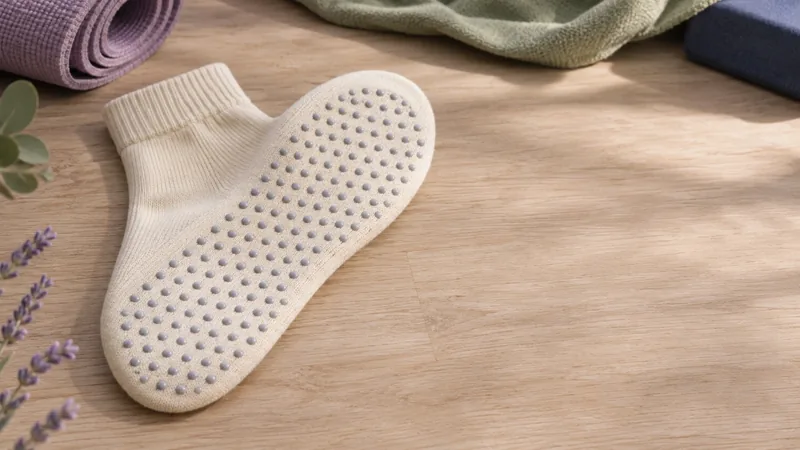
This guide is for studios and wellness brands specifying silicone Pilates grip socks and other studio grip. It looks at the sole from the studio's side: surfaces, coverage, comfort and wording. Material science and production methods are outside its scope. For the overall style choice, see our guides to Pilates sock silhouettes and yoga and barre styles.
Our grip technology page treats silicone and PVC as material options to confirm for each project: appearance alone does not verify composition or grip performance. Grip application is coordinated with external specialists, and pattern, placement and appearance are reviewed against the approved sample. Adhesion, wash or wear testing happens only when it is agreed for an order, with a method and acceptance criteria. We publish no slip-resistance, durability or test results, and this guide does not either.
1. What you are actually choosing
| Decision | What it covers | Confirmed by |
|---|---|---|
| Material | Requested silicone or PVC formulation and colour. | The material specification for your project and any supplier documents within their stated scope. |
| Pattern | Dots, triangles, bars, pads or a logo-shaped concept. | Artwork review and the physical sample. |
| Coverage | Full sole or selected zones, including toe and heel boundaries. | The sole outline marked on the layout and checked on the sample. |
| Placement | Position relative to toe, heel and sole edge on every size. | Samples across the size range. |
| Evaluation | Any grip, wash or wear check you need. | An agreed method and acceptance criteria, only if requested. |
Asking for "silicone" fixes only the first row. The other rows decide what members notice in class.
2. Studio floors, mats and equipment
A studio sock meets several surfaces in one session. Name them in the brief, so the sample can be reviewed where it will be used:
- Studio floor: wood, vinyl or another finish, sometimes with cleaning products on it. Note what your floor is.
- Mats: for yoga and mat Pilates, the sole sits on the mat surface for most of the class.
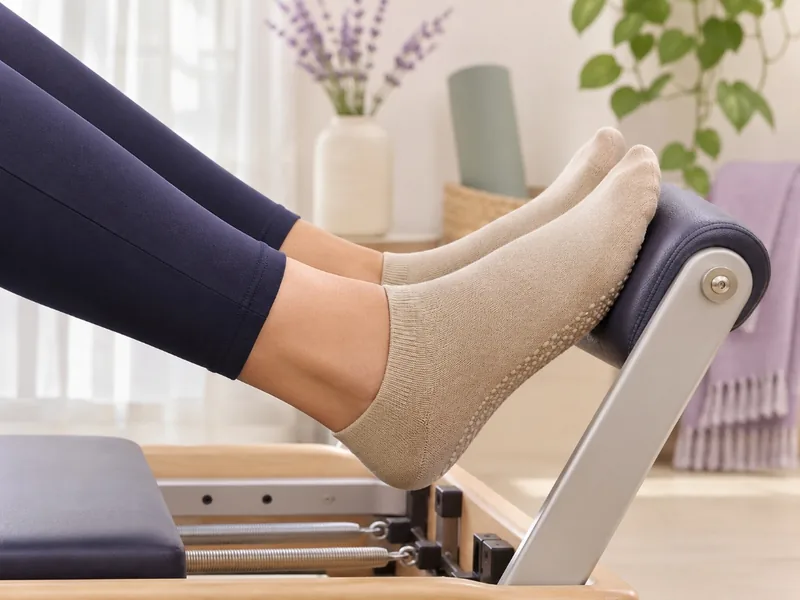
- Reformers and other equipment: the foot bar, carriage and platforms. Follow the equipment maker's and the instructor's guidance on footwear.
- Barre: standing work on the studio floor, often with rises onto the forefoot.
Review the sample on each surface with an instructor present. Record what you observe, but do not turn those observations into a grip claim without an agreed test.
3. Coverage and pattern
Coverage should follow how the foot is used in class, not a default "more is better":
- Full sole: grip spread from heel to forefoot within an agreed boundary.
- Targeted zones: grip concentrated under the forefoot and heel, leaving other areas plain.
- Toe areas: on five-toe styles, grip under individual toes as well as the sole.
- Edge clearance: how close the pattern comes to the sock edges and the heel sidewall.
Our current studio references show circular dots on the closed-toe Pilates styles, and triangular pads or round dots on the five-toe yoga styles:
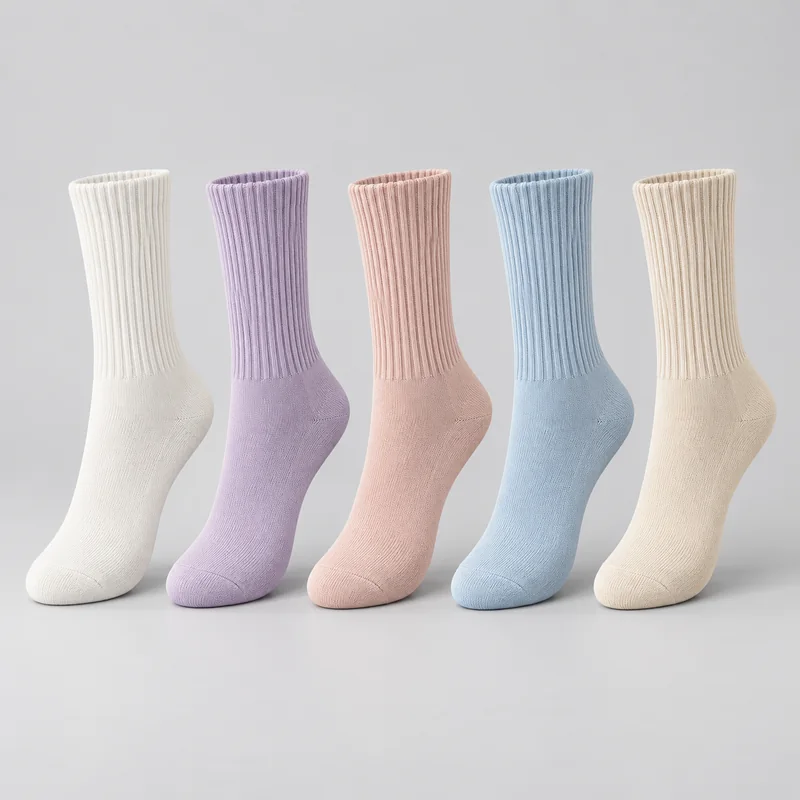
Custom Ribbed Crew Yoga Grip Socks
A closed-toe ribbed crew style with circular sole grip dots. Plan pastel colours, XS to L sizes and branded packaging for studio and wellness retail.
View Product Details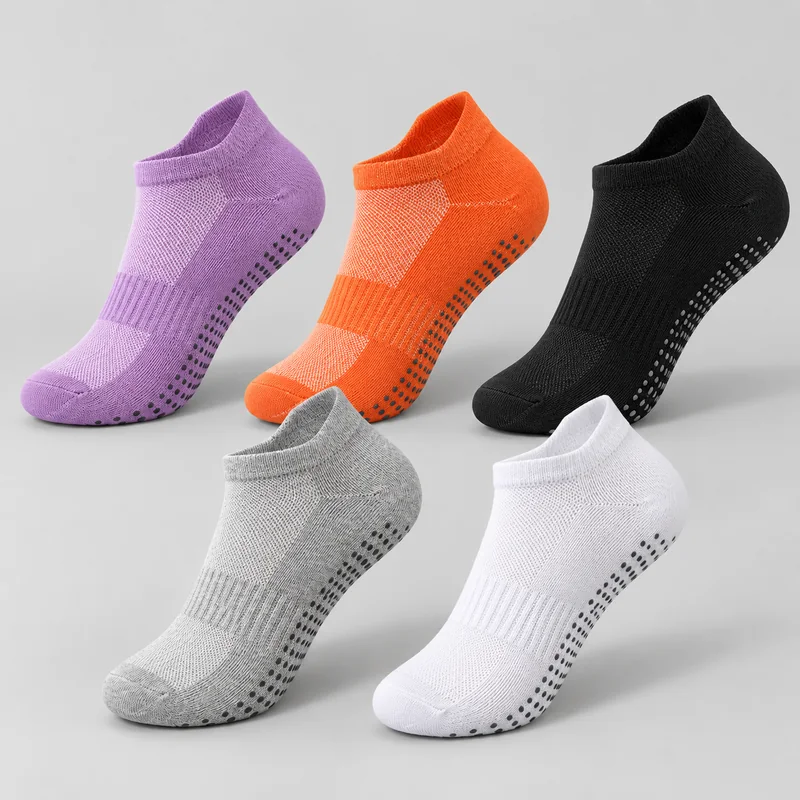
Custom Low-Cut Mesh Yoga Grip Socks
A low-cut style with mesh-knit zones, ribbed midfoot and circular sole grip dots. Develop custom colours, XS to L sizes and branded studio retail packs.
View Product Details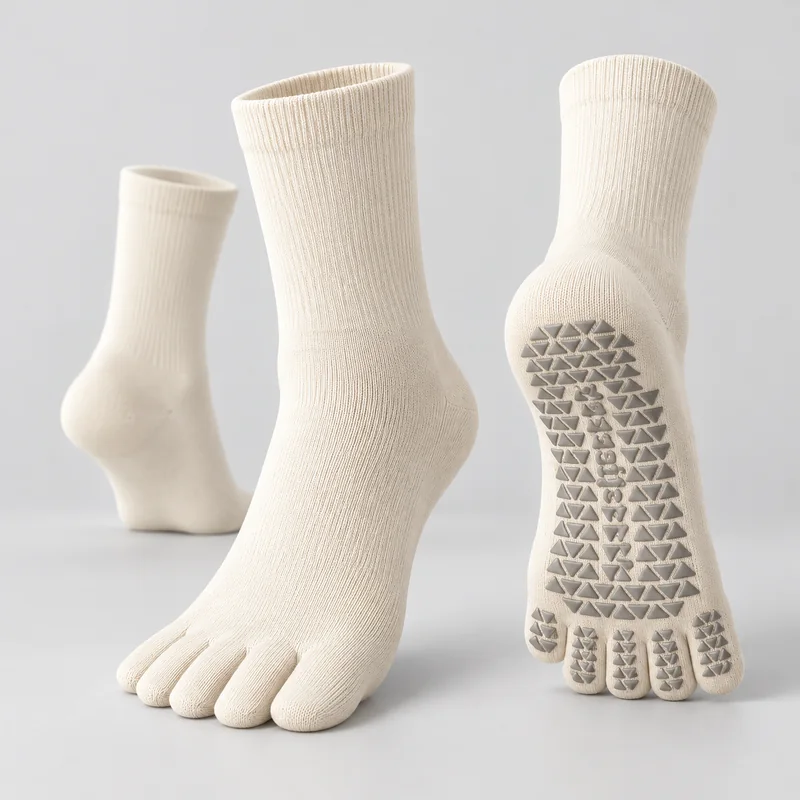
Custom Five-Toe Yoga & Barre Grip Socks
Five separate closed toes, ribbed crew cuffs and triangular sole grip. Explore six neutral colours, fit planning and private label studio packaging.
View Product DetailsEach page asks for the grip material, layout and coverage to be confirmed on the sample for each size.
4. Comfort: the grip and the knit together
Grip sits on a knitted surface that stretches as it is worn. On the sample, check:
- Feel underfoot: whether testers notice the pattern through the sole during a full class.
- Stretch: how the pattern looks and sits when the sock is on a foot, not only when it lies flat.
- Size range: whether the pattern still sits under the forefoot and heel on the smallest and largest sizes.
- Toe and heel boundaries: whether pads reach where they should and stop where they should.
A grip layout that looks right on a flat sample can sit differently on a foot, so always review it worn.
5. Confirming silicone or PVC
Ask for the material as part of the specification. The confirmation should be clear on:
- The requested material: silicone, PVC or another option, and its colour.
- Supporting documents: any supplier documentation for the grip material, used only within the scope it states.
- The sample: the approved sample is made with the confirmed material, and it becomes the reference for bulk.
- Reorders: any change of material or supplier is listed as a change, with a new sample or checks if needed.
Do not identify a grip material from a photograph, including product photos. Our approval checklist records the grip material, colour, placement and coverage boundary with the sample.
6. Testing: only what you agree
If you need evidence of how the grip holds up, agree it before sampling:
- Method: which test, on which surface, after how many washes.
- Acceptance criteria: what result counts as a pass for your use.
- Who runs it: an agreed check at the factory, a specialist, or an external laboratory.
- Repeat rule: whether the same test is needed after a specification change.
A layout image or a sample worn in one class is not a performance test.
7. How to describe the grip
Words such as non-slip, anti-slip or slip-resistant are objective claims. In the US, the FTC expects advertisers to have a reasonable basis for objective claims before they are made (FTC Policy Statement Regarding Advertising Substantiation), and other markets have similar rules. Safer wording describes the build:
| Approach | Example | Evidence needed |
|---|---|---|
| Describe the build | "[Material] grip dots across the sole." | The confirmed specification. |
| Describe the use | "Designed for studio classes. Follow your instructor's footwear guidance." | None beyond the product itself. |
| Performance claim | "Non-slip on all studio floors." | Agreed tests on the stated surfaces; hard to support broadly, so avoid. |
Example wording with a field to complete. Not legal advice; confirm pack wording for each market.
8. Sole brief checklist
| Decision | Include in your brief | Approve on the sample |
|---|---|---|
| Use and surfaces | Classes, floor type, mats and equipment. | Worn review on each surface with an instructor. |
| Material | Requested silicone or PVC and grip colour. | Confirmed material in the written specification. |
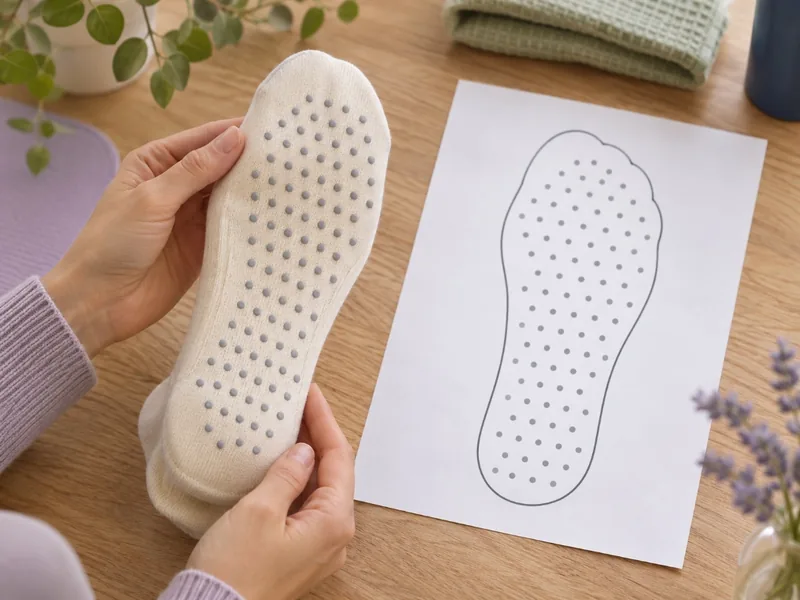
| Layout | Bottom-view reference, coverage and boundaries. | Complete pattern on every size, nothing missing or displaced. |
| Testing and wording | Any test needed and the pack wording you plan. | Agreed method, criteria and results before any claim. |
Frequently asked questions
Are silicone grip socks better than PVC for Pilates?
We make no general comparison. Silicone and PVC are material options confirmed for each project, and the layout, coverage and knit matter as much in class. Compare samples on your own floors and equipment.
How can we tell if a grip sock uses silicone?
Not from a photo. Ask for the material specification and any supplier documents within their stated scope, and record the confirmed material with the approved sample.
Can we call our studio socks non-slip?
Only with evidence for the claim as worded, such as agreed tests on the stated surfaces. Describing the build, for example grip dots across the sole, is the safer approach.
Should a studio sock have full-sole grip?
Not necessarily. Full-sole and targeted coverage both exist; choose by how the foot is used in your classes and confirm the boundaries on a worn sample.
Is grip testing included with every sample?
No. Adhesion, wash or wear testing is agreed for an order with its method and acceptance criteria. Pattern, placement and appearance are reviewed against the approved sample.
Next steps
Review what to confirm on the grip technology page, compare sole layouts on Pilates and yoga and barre styles, and send your sole reference and surfaces through the quote form.