Most new sock brands should start with one base style, two to four colours and only the size bands their customers actually wear. Count the lines first: styles × colours × sizes. Multiply by the minimum quoted for that blank style, then check the result against expected sales and the cash you can tie up. Blank socks are quoted per style, so do not use the published grip-sock minimum as your starting figure.
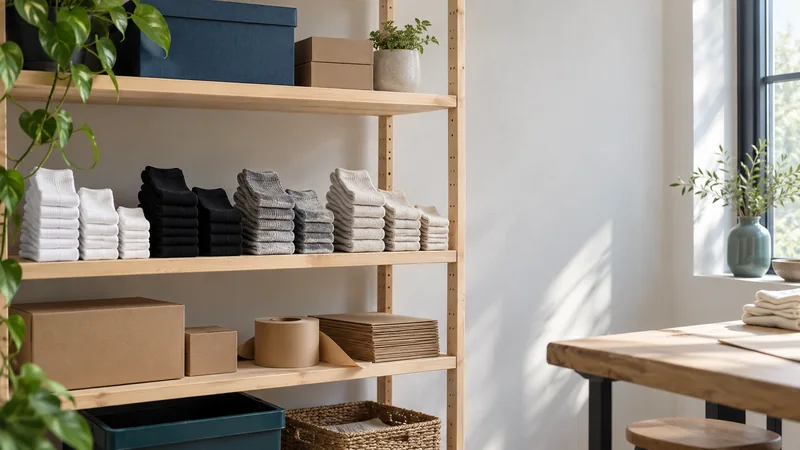
Starting a sock brand on a white label base is a sensible way to reach the market without developing a new construction. The risk moves from product development to inventory: a first order with too many colours and sizes can leave slow lines on the shelf. Our white label launch page covers the overall route, from base selection to branding and sample approval. This guide covers one decision only: how much first stock to buy, and in what mix.
We do not quote a fixed minimum for blank socks. MOQ, sample timing and bulk lead time are confirmed for the selected yarn, colours, sizes, branding and packaging. The published 50-pair condition applies only to standard grip styles, so this guide does not use it for blank socks. Product directions shown on the site are not a live inventory list, and a white label route does not mean ready-to-ship stock. All quantities below are arithmetic examples with fields to complete, not recommendations.
1. Choose one base style to launch with
Each extra style needs its own sample, size lines, colour lines and reorder record. A first range built on one base style is easier to photograph, describe, price and restock. Our current white label range has three blank crew directions:
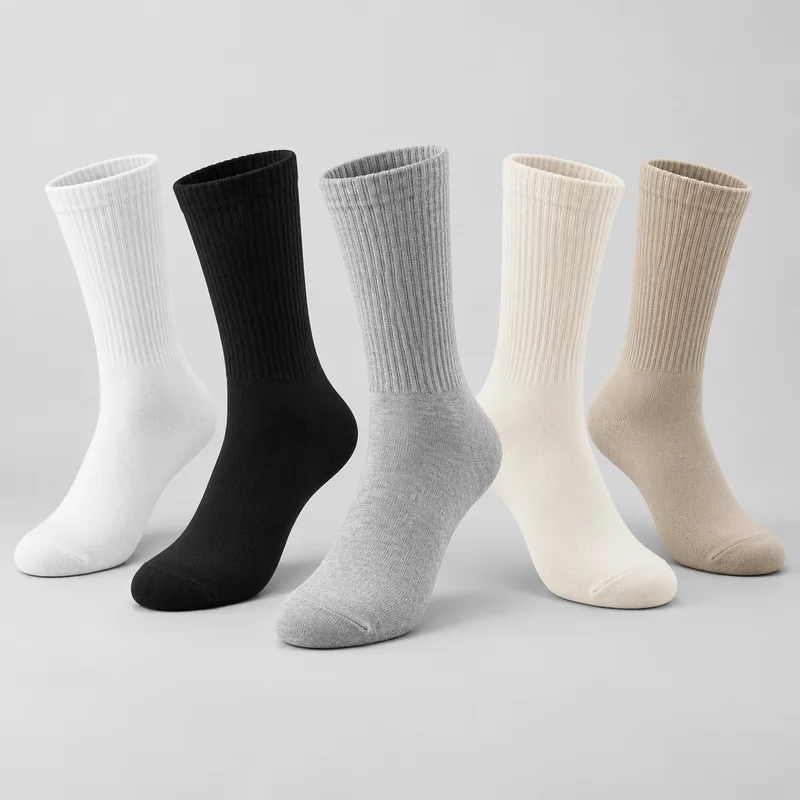
Custom Blank Ribbed Crew Socks
A plain ribbed crew sock in five neutral colour directions. Plan XS to L sizes, custom branding and retail packaging for your basics range.
View Product Details →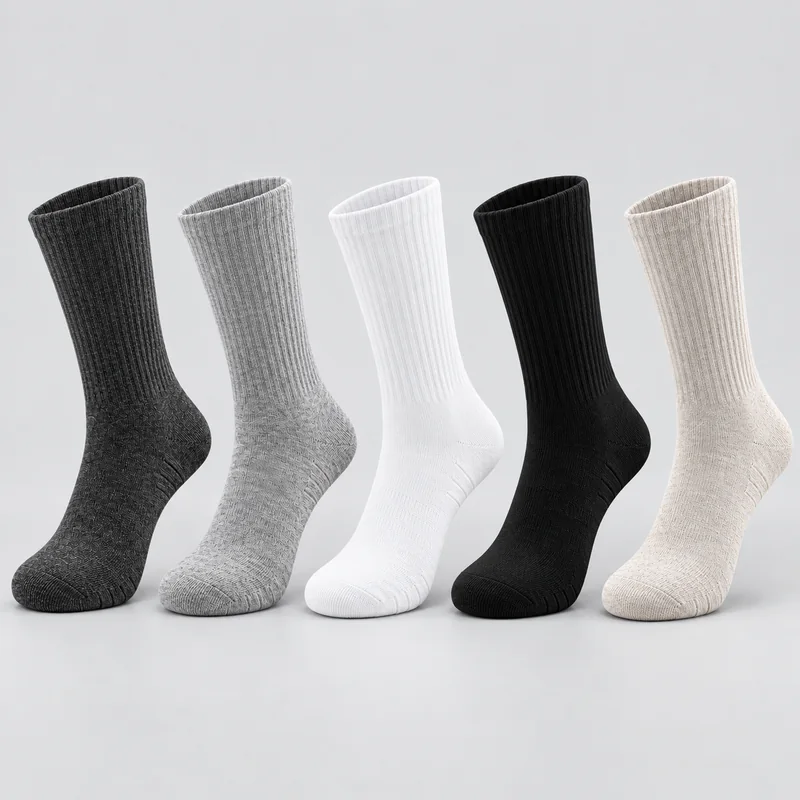
Custom Cotton-Blend Blank Crew Socks
A cotton-blend blank crew style with ribbed cuffs and heather or solid neutral colours. Plan youth-to-adult sizes, branding and retail packaging.
View Product Details →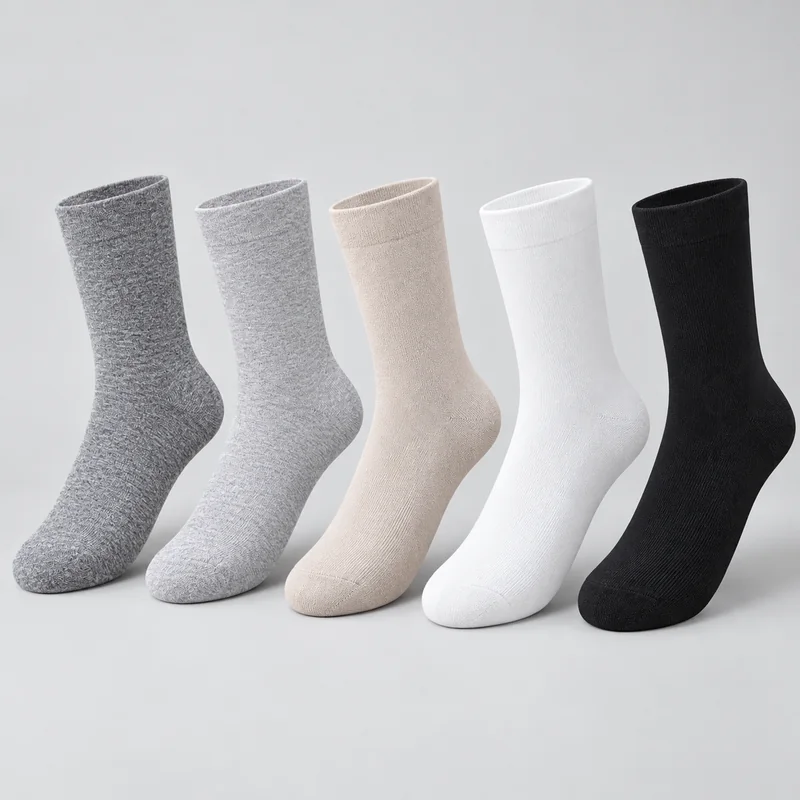
Custom Plain Knit Blank Crew Socks
A plain knit blank crew style with ribbed cuffs and five neutral colour references. Plan youth and adult sizes, branding, retail packs and repeat orders.
View Product Details →They differ in ways that affect the brand story rather than the order arithmetic:
- Blank ribbed crew: a ribbed crew leg and plain knitted foot. Shown in white, black, heather grey, cream and sand. Sizes are planned from XS to L.
- Cotton-blend blank crew: the only one of the three with a published reference composition (74% cotton, 23% polyester and 3% spandex, on a 168-needle knit reference). It also has a plain branding area. The final blend is still confirmed on your sample.
- Plain knit blank crew: a smooth plain-knit body with a ribbed cuff. Yarn and knit specification are agreed during sampling.
If you are not sure which base fits, choose by how you will describe the product to customers: texture, feel, or a stated fibre blend. Then confirm the base style is available before you set a launch date.
2. Start with core colours
Colour is usually what multiplies a sock range fastest, because each colour is a separate line in every size. For a first order:
- Core neutrals carry the range. One or two colours you expect to reorder, such as white and black, or a heather grey.
- Add one or two brand colours. Shades that make the range recognisably yours. Treat them as a test.
- Leave seasonal shades for later. Once the base and size chart are approved, a new colour mostly changes the yarn shade. It does not restart development.
Multipacks need the same care. A three-pack in three colours still needs each of those colours as its own line. Decide whether you will sell single pairs, packs or both before you count lines.
3. Decide how many size bands you need
Socks are sold in bands that each cover several shoe sizes, so a range needs fewer sizes than footwear. The right number depends on who buys from you:
| Size structure | When it can work | Watch for |
|---|---|---|
| 2 bands (e.g. S/M and L/XL) | A unisex adult range where customers accept wider bands. | Fit at the ends of each band. Check the smallest and largest feet in each band on samples. |
| 3 bands (e.g. S, M, L) | A common starting point for adult ranges in one market. | Which band will sell most. It is rarely an even split. |
| 4+ bands, or youth sizes | Brands selling to families, or to customers at both ends of the size range. | More lines at the minimum. Consider adding these once core sizes are selling. |
Base the band boundaries on foot length and the size systems of the markets you sell to. Our guide to US, UK, EU and Australian sock sizes explains how to keep one size range consistent across markets.
4. Count lines before pairs
A line is one style in one colour and one size. Minimums are confirmed per line for the blank style you choose, so the line count drives the size of the first order:
| Example structure | Lines | Smallest order |
|---|---|---|
| 1 style × 2 colours × 2 sizes | 4 | 4 × [quoted minimum per line] |
| 1 style × 3 colours × 3 sizes | 9 | 9 × [quoted minimum per line] |
| 1 style × 5 colours × 3 sizes | 15 | 15 × [quoted minimum per line] |
| 2 styles × 3 colours × 3 sizes | 18 | 18 × [quoted minimum per line] |
Arithmetic examples. Complete the bracketed field with the minimum in your quotation for the selected blank style, which may also differ for packaging. Do not pool small quantities across lines to meet a per-line minimum unless the quotation says it is allowed.
Going from three colours to five adds six lines, which is two-thirds more stock at the minimum. Before adding a line, ask whether you would reorder it.
5. Work out the cash tied up in stock
Inventory is cash you cannot spend on photography, advertising or the reorder. Estimate it before you place the order, using figures from your quotation and freight quotes:
- Landed cost per pair = [sock price] + [packaging per pair] + [freight per pair] + [duties and import costs per pair, if any].
- First-order cash = total pairs × landed cost per pair, plus one-off costs such as samples, artwork or packaging set-up.
- Weeks of cover per line = pairs in the line ÷ expected pairs sold per week.
- Reorder point = expected weekly sales × [weeks from reorder to stock arriving], confirmed in each quotation.
If a line gives you many more weeks of cover than the others, its minimum is probably too large for its demand. Remove it, or merge it into a core colour. If the whole order is beyond your cash limit, cut lines, not pairs per line.
6. Test demand before and after the first order
A new brand has no sales history, so use the cheapest evidence you can collect before choosing quantities:
- Sample feedback. Use approved samples for photography and wear trials, and ask target customers which colours they would buy.
- A pre-order or waitlist. Show the colours and sizes and count sign-ups or pre-orders per line. Only promise a delivery date after production and transport are confirmed.
- Existing customer data. If you already sell apparel or footwear, use your own size and colour split.
- Sell-through by size after launch. Track each line weekly, not total pairs. Sock ranges often run out of one size first.
Then reorder what sells. Our launch planning page calls this "launch and learn": add colourways, packaging upgrades or deeper customisation once sales give you a reason.
7. Keep branding and packaging inside the plan
Branding and packaging can add their own minimums and set-up steps. Decide early:
- Brand on the sock or only on the pack. A label, band or hangtag can brand a blank sock without changing the knit. Knitted, embroidered or printed branding needs review on the chosen construction.
- One pack format. Use a single band, header card or bag for the whole first range. Different formats per channel multiply packaging lines.
- Label content. Size band, confirmed fibre composition, care instructions and barcodes for each line.
Our private label page shows the packaging directions, and each blank style page shows the formats pictured for that style.
8. Approve one packed sample per line type
| Decision | Include in your brief | Approve on the sample |
|---|---|---|
| Base style | Preferred blank style, use and target customer. | Confirmed availability, yarn composition, thickness and crew height. |
| Colours | Core and brand colours with shade references. | Knitted shade on the selected yarn, kept as the colour standard. |
| Size bands | Bands, foot-length ranges and the size systems you will print. | Finished measurements and fit at both ends of each band. |
| Lines and quantities | Pairs per style, colour and size, plus pack format. | The quotation's minimums, sample timing, bulk timing and packaging costs. |
| Pack and label | Artwork, size label, composition, care and barcode needs. | One finished pack exactly as customers will receive it. |
Keep the approved sample, colour standards and size chart as the reference for every reorder. Our quality and reorders page explains how approved versions are kept reusable.
Frequently asked questions
How many colours should a new sock brand start with?
There is no fixed number, but many brands start with two to four: one or two core neutrals they expect to reorder, plus one or two brand colours. Each colour adds a line in every size, so add colours only when you can sell and restock them.
What is the minimum order for blank socks?
MOQ, sample timing and bulk lead time for blank socks are quoted for the selected yarn, colours, sizes, branding and packaging. The published 50-pair minimum applies only to standard grip styles. Send pairs per style, colour and size for a quotation.
Are the blank socks on your site in stock?
No stock is implied. The styles shown are base directions, not a live inventory list. Availability, production quantities and timing are confirmed for each project.
How many sizes do socks need?
Socks are sold in bands that cover several shoe sizes. Two or three adult bands are common starting points; youth sizes add lines. Set band boundaries by foot length and confirm fit on samples.
Can we brand blank socks without changing the knit?
Yes. Bands, hangtags, header cards and bags can carry the brand. Knitted, embroidered or printed branding is reviewed against the chosen construction and approved on a sample before production.
Next steps
Compare the three base styles on the white label range, check how lines are counted on Samples & MOQ, then send your first-order brief through the quote form.