Shoe-size numbers do not convert exactly between markets, so plan a sock range from foot length. Group foot lengths into a few bands (for example S, M, L and XL). Show each band in the systems your customers use: EU, UK, US men's and US women's, with Australia usually following UK for men and US for women. Print the same band on the sock label, the pack, the carton and the product page, and approve finished measurements on samples.
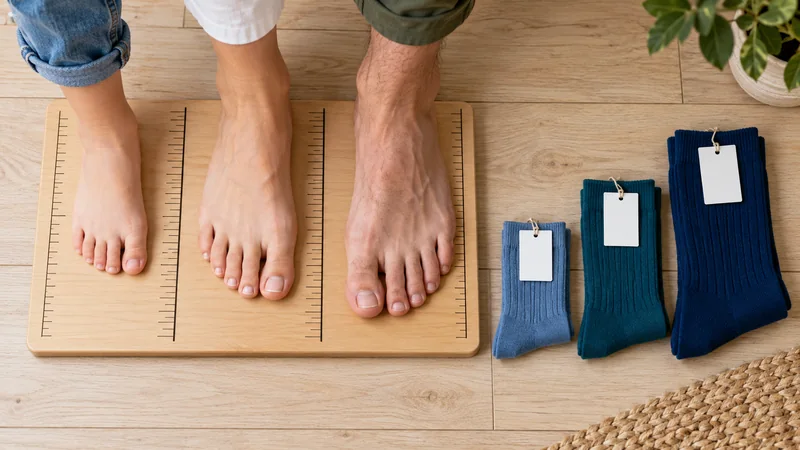
A brand selling in more than one country soon finds that "size 8" means different things. A UK 8 and a US men's 8 are different sizes, a US women's 8 is smaller again, and the EU uses a different scale entirely. Socks add one more layer, because each sock size covers a range of shoe sizes. This guide explains how to turn those systems into one consistent size range. Our Samples & MOQ page covers how the number of sizes affects order quantities.
Use the fillable size confirmation worksheet →
Shoe size conversions are approximate and vary between brands and footwear types. The chart below is an illustrative planning mapping, not our size chart and not a fit guarantee. Final size charts, finished measurements and labels are agreed for each style on physical samples.
1. How the four size systems work
Each system was built on its own unit, which is why the numbers never line up neatly:
- UK counts in barleycorns (a third of an inch). Children's sizes run up to 13½, then adult sizes start again at 1. Men's and women's adult sizes broadly share one scale.
- US uses a similar step but a different starting point, and separates men's and women's scales. A US men's size is commonly about one size above the UK number. A US women's size is commonly about two above UK, or about 1½ above US men's.
- EU (Continental) counts in Paris points (two-thirds of a centimetre) and uses one scale for men and women, typically from the mid-30s to around 50 for adults.
- Australia commonly follows UK numbers for men's footwear and US numbers for women's. Many Australian sock packs print a shoe-size range, so state whether it refers to men's or women's sizes.
Foot length is the common reference behind all of them. The Mondopoint system (ISO 9407) labels footwear directly by foot length in millimetres. That is why foot length makes a reliable base for a multi-market sock range.
2. Start from foot length
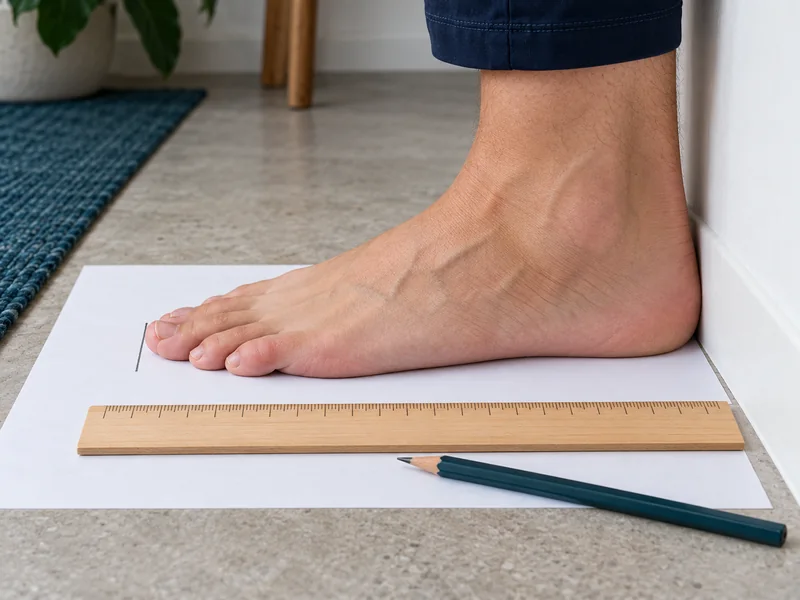
Define each size band by a foot-length range first, then add the shoe-size labels. To collect foot lengths from wearers, testers or a team:
- Stand with the heel against a wall, weight evenly on both feet.
- Mark the tip of the longest toe and measure from the wall to the mark.
- Measure both feet and use the longer measurement.
- Measure later in the day, when feet are usually at their largest.
For a retail brand, ask your target customers for their usual shoe size in their own system, then convert to foot length with the chart below. For a club or team, collect foot lengths directly. They are more reliable than shoe sizes reported from memory.
3. An illustrative sock size conversion chart
The mapping below groups adult foot lengths into four 2 cm bands, a common structure for sports socks. The illustrated size guide on our ribbed training grip socks page uses the same EU groups and foot-length ranges. That page also notes that the final UK, US, EU or Australian mapping is agreed for each customer group before labels are printed.
| Band | Foot length (approx.) | EU | UK and AU men's | US men's | US and AU women's |
|---|---|---|---|---|---|
| S | 22–24 cm | 35–38 | 2½–5½ | 3½–6½ | 4½–7½ |
| M | 24–26 cm | 39–42 | 6–8½ | 7–9½ | 8–10½ |
| L | 26–28 cm | 43–46 | 9–11½ | 10–12½ | 11–13½ |
| XL | 28–30 cm | 47–50 | 12–14 | 13–15 | Usually not needed |
Illustrative planning mapping only. Shoe-size conversions vary between brands; use this to frame a discussion, then approve your own size chart on samples. Australian sizes vary by brand and are shown under the system they most commonly follow.
4. Men's, women's and unisex labels
The most common labelling problem is a unisex band that shows only one gender's numbers. A woman who wears a US 8 and sees "US 7–9½" on a pack may pick the wrong band, because that range is in men's sizes. Options:
- Unisex range, both scales. Print men's and women's ranges for each band, such as "US M 7–9½ / W 8–10½". This is the clearest option for most sports socks.
- Separate men's and women's ranges. Useful when the styles differ in fit or colour, but it adds lines and reorder records.
- Letter only (S/M/L). Avoid this on its own. Letters mean different things across brands, so always add the numeric ranges.
Even within one catalogue, letter ranges differ by style. Our ribbed crew yoga grip socks and blank ribbed crew socks plan sizes from XS to L. The striped crew yoga grip socks plan S to XL. If you combine styles in one range, line the bands up by foot length before you print a shared size chart.
5. Youth and children's sizes
Children's shoe sizes use separate scales in the UK and US, and adult sizing restarts after the largest children's size. Conversions between markets are even less consistent than for adults. Define youth bands by foot length, use age only as a secondary guide, and check whether youth bands should overlap with your adult S. If your range includes youth sizes, product pages such as our crew football grip socks and cotton-blend blank crew socks show how youth-to-adult planning is presented. Final measurements are confirmed on samples.
6. How many bands should the range have?
Each band is a separate size line for every style and colour, so the number of bands sets the size of the order as well as the fit:
| Structure | Fit | Order and stock |
|---|---|---|
| 2 wide bands | Each band covers about 4 cm of foot length; check the ends of each band carefully. | Fewest lines and simplest restocking. |
| 3 bands | A common middle route for adult ranges. | One more line per colour than two bands. |
| 4 bands (S–XL) | Closer fit across a wide adult range. | More lines; check your own customer data before adding an XL band. |
For standard grip styles, the published minimum applies to each style, colour and size, so adding a band adds a full line in every colour. Other sock types are quoted for their own construction. See Samples & MOQ for how lines are counted.
7. Keep labels consistent everywhere
Once the bands are set, the band is the product. The same band should read the same way wherever the customer, the warehouse or a retailer meets it:
- Sock and pack labels: the band letter plus numeric ranges in the systems you sell in. Use a fixed order, such as EU / UK / US.
- Product pages and size charts: the same ranges as the pack, plus foot length.
- Cartons and allocation sheets: the band letter and colour, matching the pack.
- The specification: band boundaries, finished measurements and label artwork recorded with the approved sample. If you change a boundary later, treat it as a new version, not a reorder.
8. Confirm the fit on samples
A converted number is only a starting point. Knitted socks stretch, and the same nominal size can fit differently depending on yarn, knit and height. On samples of each band, check:
| Check | Include in your brief | Approve on the sample |
|---|---|---|
| Band boundaries | Foot-length ranges and the size systems to print. | The final size chart for this style. |
| Finished measurements | Any target sock foot length, leg length or cuff width. | Flat measurements per band, recorded in the specification. |
| Fit at the ends | Testers at the smallest and largest foot in each band. | Heel position and toe room on both testers. |
| Grip placement (grip socks) | Sole pattern reference. | Pad or dot placement under the foot on every band. |
| Labels | Label and pack artwork for each band. | Size information that matches the chart exactly. |
Our customization page treats size labels and size identification as part of the packaging specification. Our product pages note that illustrated size labels are planning references until the sample fit is approved.
Complete a size range confirmation record
Use one record for each style and sample version. Keep the agreed size chart, label artwork and fit observations together; do not copy the illustrative conversion table into a production specification without confirming the fit. For venue quantities and packing, continue with the venue order record.
Size range and sample confirmation record
Build your own style-specific record. Start with foot lengths in millimetres, then enter the labels and sample observations you want to review. Leave anything unconfirmed blank.
Entries stay in this page and are not sent to us or saved by this tool. Download your record before leaving. All fields are optional; blank fields remain unconfirmed.
Start with the details you know.
This is a planning record, not a quotation or supplier approval. To discuss it, copy the relevant entries into the quote form, or print to PDF and attach that file there.
Frequently asked questions
How do UK and US sock sizes compare?
As a common approximation, a US men's shoe size is about one above the UK size and a US women's size about two above. Conversions vary between brands, so build sock bands from foot length and print both systems where you sell in both markets.
What size system does Australia use for socks?
Australian footwear commonly follows UK numbers for men and US numbers for women, and many sock packs print a shoe-size range. State on the pack whether the range is men's or women's, or print both.
What does sock size M usually cover?
There is no universal definition. In the illustrative four-band mapping above, M covers about 24–26 cm of foot length, EU 39–42. Always define your own bands and show the numeric ranges, not only the letter.
Should we print EU, UK and US sizes on every pack?
Print the systems used in the markets where that pack is sold, in a fixed order. A pack sold in several markets usually carries EU, UK and US ranges, with men's and women's US ranges for unisex bands.
Is your size chart the same for every style?
No. Illustrated size labels on our product pages are planning references. The final size chart, finished measurements and fit are confirmed for each style and order on physical samples.
Next steps
Choose your bands, then check how they affect quantities on Samples & MOQ. Planning a first retail range? Our guide to how many colours and sizes a new sock brand should stock applies the same line count. Send your markets and size list through the quote form.