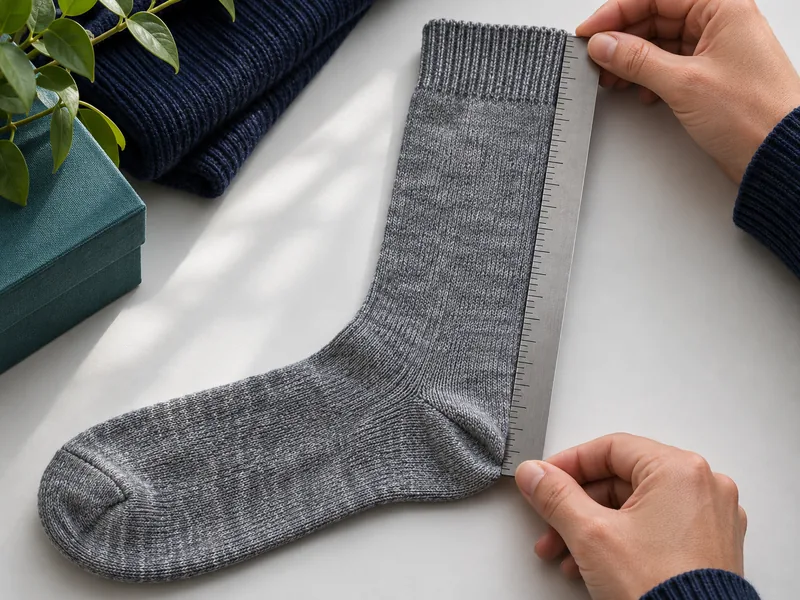
To check the quality of a blank crew sock sample, measure it flat before washing: foot length, leg length and relaxed cuff width. Then wash and dry it exactly as your care label will say, and measure again after one and several cycles. Work out the change as a percentage. Check the cuff by stretching it in a fixed way and measuring how far it comes back. Compare colour, heather effect, surface and rib lines with an unwashed sock. Finally, try the washed sock on people at the smallest and largest end of each size band, and record everything against the sample code.
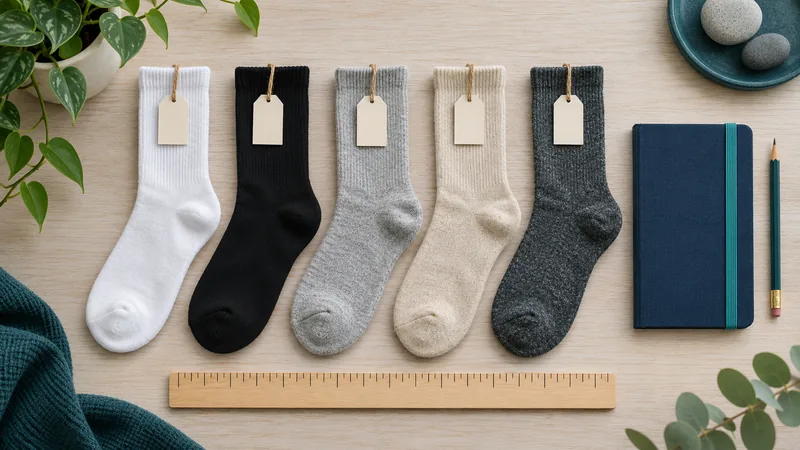
Our quality and reorders page explains how an approved sample becomes the reference for every repeat order. This guide goes one level deeper for blank crew socks: what to measure, how to wash, how to check the cuff and what to record, so the reference means the same thing to you and the factory. It uses our three blank crew styles as examples.
We do not publish shrinkage, recovery or wash-life figures for any style. The blank style pages ask for finished measurements, stretch and cuff fit to be approved on samples, and our quality page lists wash or other tests as additional checks agreed with acceptance criteria for an order. They are not automatic. The methods below are buyer-side comparison checks, not certified test results.
1. The blank crew styles this applies to
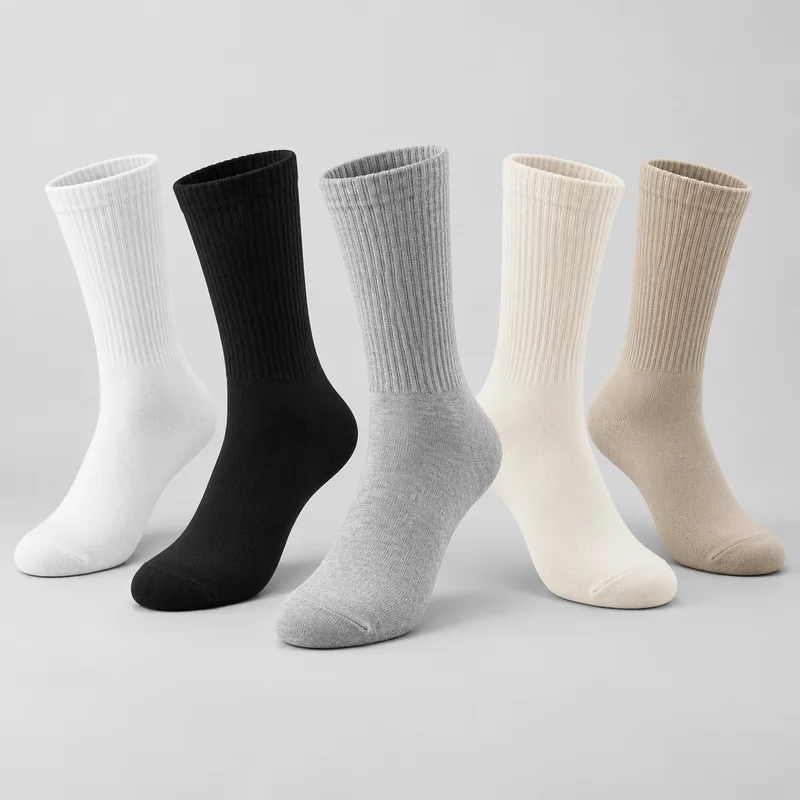
Custom Blank Ribbed Crew Socks
A plain ribbed crew sock in five neutral colour directions. Plan XS to L sizes, custom branding and retail packaging for your basics range.
View Product Details →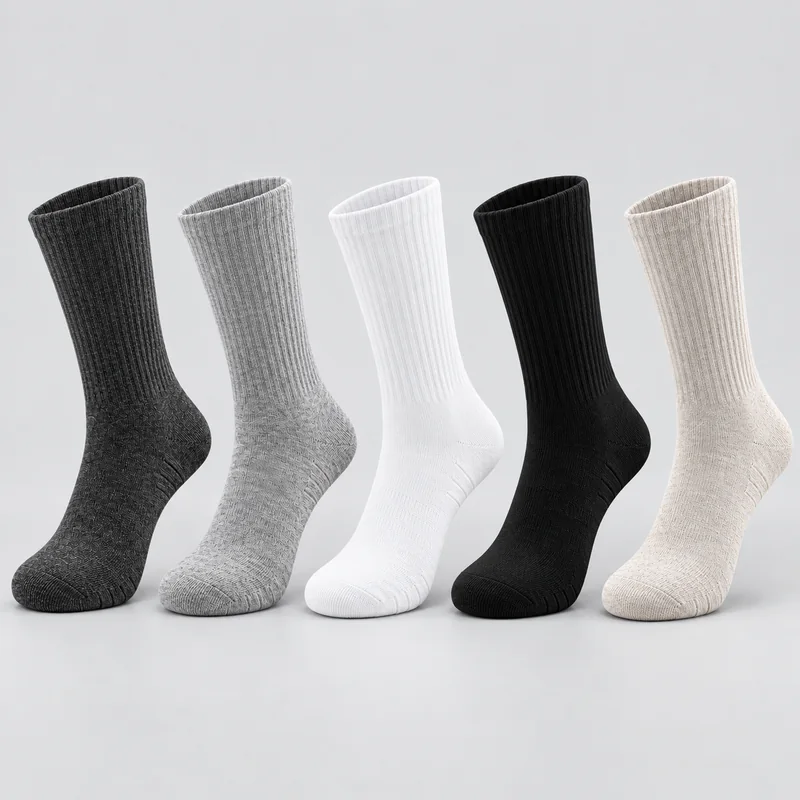
Custom Cotton-Blend Blank Crew Socks
A cotton-blend blank crew style with ribbed cuffs and heather or solid neutral colours. Plan youth-to-adult sizes, branding and retail packaging.
View Product Details →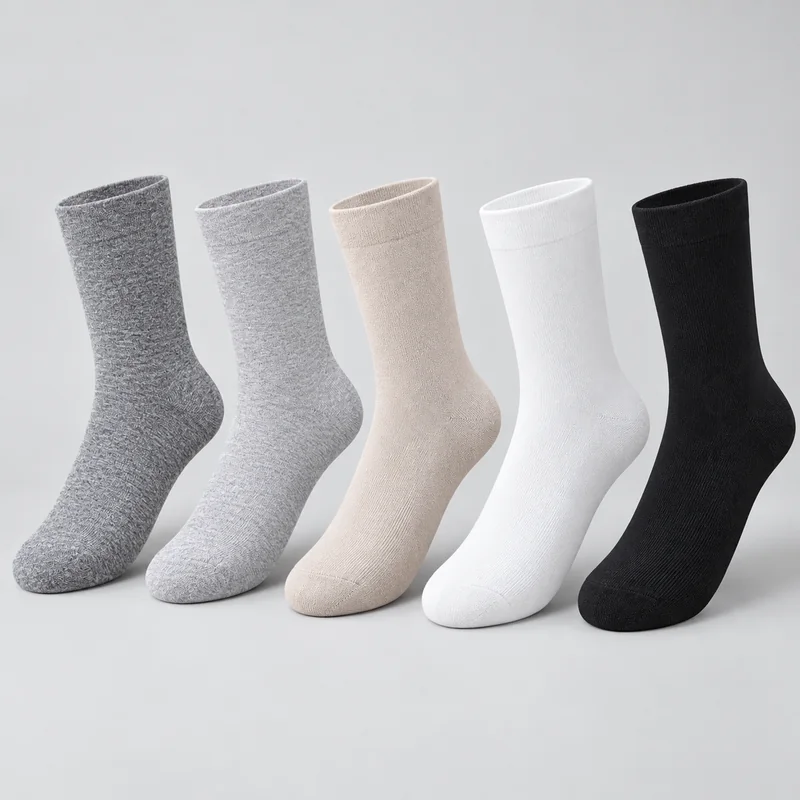
Custom Plain Knit Blank Crew Socks
A plain knit blank crew style with ribbed cuffs and five neutral colour references. Plan youth and adult sizes, branding, retail packs and repeat orders.
View Product Details →Each one gives a slightly different emphasis to the checks:
- Blank ribbed crew: a ribbed leg and plain knitted foot. Rib lines show twisting or uneven stretch clearly, so check that they stay straight after washing.
- Cotton-blend blank crew: a published reference composition of 74% cotton, 23% polyester and 3% spandex. Cotton-rich blends can be more sensitive to hot washing and tumble drying, so match the wash to the care label you intend to print.
- Plain knit blank crew: a smooth body where surface changes such as pilling and fuzz are easy to see. Its size image includes foot-length and leg-height measurements, which are useful starting points for the measure points below.
The heather shades on these styles (charcoal heather, light heather grey) mix fibres or shades in the yarn, so check the colour effect after washing as well as solid shades.
2. Measure before washing
Agree the measure points and method with the factory first. Our quality page asks for measured points, the measurement method and agreed tolerances to be written into the approval, so use the same points for every check:
- Condition the socks. Leave them flat in the same room for a day so they settle before measuring.
- Lay flat without stretching. Smooth the sock on a table with the heel folded naturally, as it lies when relaxed.
- Foot length: from the back of the heel fold to the tip of the toe.
- Leg length: from the heel fold to the top of the cuff.
- Relaxed cuff width: straight across the top of the cuff, flat and unstretched.
- Repeat on more than one sock. Measure several socks of each size and colour if you can, because single socks vary.
Mark each sock with a sample code on a tag, not with ink on the knit, and record the measurements against that code.
3. Wash and dry as the care label will say
Shrinkage depends as much on how the sock is washed and dried as on the sock itself. Test the way your customers will be told to care for it:
- Write the proposed care label first: wash temperature, drying method and any warnings.
- Follow it exactly: same programme, temperature and drying method every time. If the label allows tumble drying, test with tumble drying.
- Wash with similar items: a small load of similar garments, not a single sock in an empty drum.
- Measure after one wash and after several: some change shows in the first wash, and more can appear over the next few cycles. Decide the number of cycles before you start.
Keep at least one sock of each size and colour unwashed as the reference for appearance.
4. Work out the dimensional change
For each measure point:
Dimensional change (%) = (measurement after washing − measurement before) ÷ measurement before × 100
A negative result is shrinkage; a positive result is growth. Calculate foot length, leg length and cuff width separately, because they can change differently. Then compare the result with the tolerance you agree for the order, entered as [±x%] in the specification. We do not suggest a tolerance figure here; it depends on your size chart, your market and the agreed method.
| Measure point | Before washing | After [n] washes | Change |
|---|---|---|---|
| Foot length | [cm] | [cm] | [%] |
| Leg length | [cm] | [cm] | [%] |
| Relaxed cuff width | [cm] | [cm] | [%] |
Record template with fields to complete. Use one table per sample code, size and colour.
5. Check cuff recovery
The cuff is the part customers notice first when a sock starts to slip down. A simple comparison check:
- Measure the relaxed cuff width as in section 2.
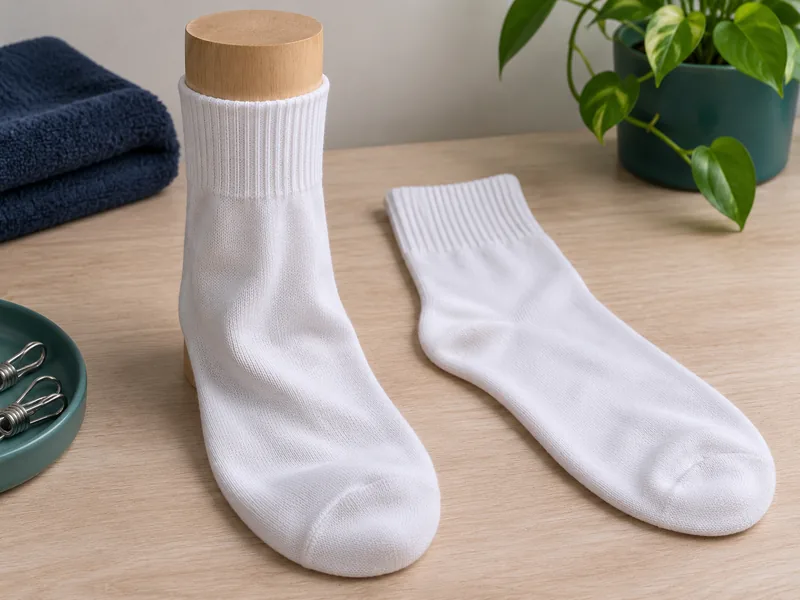
- Stretch it the same way each time: for example, pull the cuff over a fixed cylinder or a sizing block of a set width and leave it for a set time.
- Let it rest flat for a set time, then measure the relaxed width again.
- Repeat after washing to see whether recovery changes over the wash cycles.
- Wear-check: ask testers to wear the sock for a full day and note whether the cuff stayed up or rolled.
A cuff that measures wider after resting has not fully recovered. Compare samples on the same method; do not compare a figure from one method with a figure from another. Elastane content, rib structure and yarn all affect cuff recovery, so record the confirmed composition with the result.
6. Compare appearance with an unwashed sock
Put a washed sock beside the unwashed reference from the same sample, in good daylight, and check:
- Colour: fading, or a change in the heather effect on mixed shades.
- Surface: pilling or fuzz, especially on the plain knit body and the heel and toe.
- Rib lines: whether ribs stay straight or twist around the leg.
- Shape: whether the heel pocket and toe still sit where they did.
- Labels: whether any printed or woven label, band or size mark is still readable.
Photograph each pair side by side and keep the photos with the record.
7. Re-check fit after washing
A small change in length matters most at the edges of a size band. After washing, ask testers whose feet are at the smallest and largest end of each band to try the socks on:
- Is the heel still in the right place, or has it moved under the foot?
- Is there still enough toe room on the largest foot in the band?
- Does the cuff sit at the same height on the leg?
If the largest feet in a band only just fit after washing, discuss the band boundaries or finished measurements during sampling. Our guide to planning a size range covers how bands are set from foot length.
8. When to use a laboratory method
Buyer-side checks are enough to choose between samples. If a retailer asks for a report, or you want agreed numbers in the specification, use a laboratory and agree the method first. Dimensional change is commonly tested by preparing and marking specimens to ISO 3759, washing and drying them to a procedure in ISO 6330, and calculating the change to ISO 5077. AATCC TM135 and TM150 are commonly used US counterparts. Ask the laboratory how it will test finished socks, which measure points it will use and which washing procedure matches your care label.
9. Keep a sample record for bulk and reorders
| Record | What to write down | Use it for |
|---|---|---|
| Sample identity | Style, sample code, revision date, colour, size, confirmed composition. | Linking every result to one exact version. |
| Method | Measure points, care label, wash programme, drying method, number of cycles, stretch method. | Repeating the same check on bulk and reorders. |
| Results | Before and after measurements, % change, cuff recovery, photos, tester notes. | Approving the sample against agreed tolerances. |
| Agreed criteria | Tolerances and any lab method in the specification. | Bulk inspection and reorder checks. |
If the yarn or construction changes for a reorder, our quality and reorders page advises rechecking the affected sizes and confirming whether an agreed test is needed again. For a new blank brand, our guide to planning first stock covers how many colours and sizes to approve.
Frequently asked questions
How do you check sock quality on a sample?
Measure the sock flat before washing, wash and dry it as the care label will say, measure again and work out the percentage change. Then check cuff recovery, compare appearance with an unwashed sock and re-check fit on testers at the edges of each size band.
How much shrinkage is acceptable for socks?
There is no single figure for every sock. Agree a tolerance for each measure point in the specification, based on your size chart, market and the agreed method. We do not publish shrinkage figures for our styles.
Do cotton-blend socks shrink more?
Cotton-rich blends can be more sensitive to hot washing and tumble drying than synthetic-led blends. Test the cotton-blend sample with the exact care label you plan to print.
How can we test cuff recovery without a lab?
Measure the relaxed cuff, stretch it the same way each time over a fixed object, let it rest and measure again. Repeat after washing and compare samples using the same method.
Is wash testing included with every sample?
No. Wash, flex, abrasion or other tests are additional checks agreed for an order, with their acceptance criteria. Include the checks you need in your brief.
Next steps
Compare the base styles on the white label range, read how approved versions are kept on quality and reorders, and send the checks you want recorded through the quote form.