For hiking socks without wool, specify "no wool or other animal hair in any yarn" and list the full intended composition: body, cuff, reinforcement and any plating yarn. Choose replacement fibres for the job (polyester, nylon, acrylic, elastane and others). Confirm yarn availability and knitting feasibility before setting a launch date, test samples in the target boots and washes, and label only the confirmed composition. Do not add broader labels such as "vegan" unless every component has been checked.
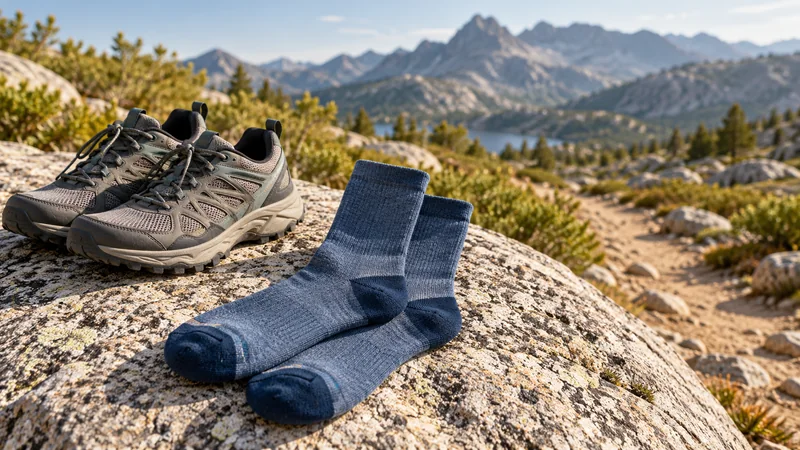
Most hiking sock guides start from merino and compare everything else with it, as our own merino vs synthetic guide does. Some customers start from a different place: they have already ruled wool out. This guide is for outdoor brands building for those customers. It covers why customers ask, how to write the specification, which fibres to consider, and what to confirm before sampling. The commercial route is on our outdoor and hiking socks page.
None of our listed outdoor styles is described as wool-free. The heather hiking style is described with wool-blend yarn options, and the other outdoor pages do not state a fixed composition. A wool-free hiking sock is therefore a composition you request in the brief, confirmed through the quotation, sample and specification. We do not use "vegan" or similar labels for any product. The fibre notes below are general textile tendencies, not results for a specific sock.
1. Why customers ask for hiking socks without wool
Customers give different reasons, and the reason affects what you need to specify:
- Feel. Some wearers find wool scratchy or uncomfortable against the skin. A wool-free label tells them only that no wool fibre is used; it is not a medical or skin-sensitivity claim.
- Animal-fibre preferences. Some customers avoid wool and other animal fibres for ethical reasons. They may also expect other components to be checked (see section 7).
- Care habits. Some customers want socks they can machine wash and tumble dry without special care. Confirm the care instructions for the actual yarn rather than assuming.
- Climate and price. Brands selling warm-weather or entry-price ranges may choose non-wool blends for the season or the price point.
Ask your customers or retail buyers which reason applies. A "feel" customer needs a soft hand; an "animal-fibre" customer needs a fully checked specification.
2. Define wool-free as a composition rule
A hiking sock can contain several yarns: the main body yarn, a plating yarn on the inside, a different yarn at the cuff, and reinforcement at the heel and toe. Wool can appear in any of them. Write the rule so it covers the whole sock:
- Exclusion: No wool or other animal hair fibre (for example merino, alpaca, cashmere, mohair, angora) in any yarn used in the sock. Add other animal fibres, such as silk, if your customers expect them excluded too.
- Full composition: [x]% [fibre] / [y]% [fibre] / [z]% elastane, completed once the yarn is confirmed.
- Coverage: body, cuff, heel and toe reinforcement, plating yarn and toe-closing thread.
- Evidence: yarn supplier information for each yarn, kept with the specification.
Writing it this way prevents a common mistake: a sock described as wool-free with a small percentage of wool blend in the cuff or reinforcement yarn.
3. Choose the replacement fibres
Without wool, most hiking socks are built from synthetic fibres, sometimes with cotton or regenerated cellulose fibres for feel. Compare them by the job each one does:
| Fibre | Commonly used for | Check on the sample |
|---|---|---|
| Polyester | Body yarns in synthetic-led blends; absorbs very little water into the fibre. | Hand feel against the skin and drying behaviour with your knit. |
| Nylon (polyamide) | Strength and reinforcement, often at the heel and toe. | Feel and wear at the reinforced zones after washing. |
| Acrylic | A soft, bulky hand in some cushioned and cooler-season socks. | Thickness in the boot, pilling and shape after washing. |
| Elastane | Stretch and recovery, usually a small percentage. | Cuff hold and shape recovery. |
| Cotton | A familiar hand feel in casual and everyday ranges; absorbs more water and tends to dry more slowly. | Whether it suits your hiking use and season at all. |
| Regenerated cellulose (viscose, modal, lyocell) | A smooth, soft feel in blends. | Strength when wet, shape after washing, and correct fibre naming (see section 7). |
General tendencies only. Availability of each fibre in your colours and yarn counts is confirmed per quotation.
Our customization page lists cotton, polyester and blends among the yarn options, and the outdoor page confirms that you can include a requested fibre blend in the brief. For each specific fibre, availability, composition and sourcing are confirmed for the selected yarn.
4. Confirm development capability first
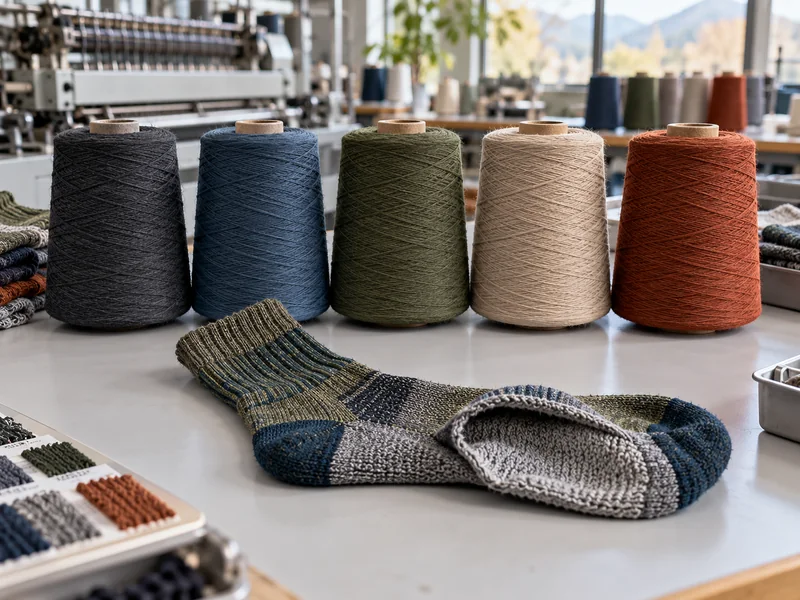
Changing the fibre can change how a construction knits and looks. Before promising a launch date, confirm these points with the factory:
- Yarn availability. The chosen fibres in your colours and yarn counts, and any yarn-specific minimum.
- The look you want. A heathered or mélange appearance comes from the yarn. Confirm that a wool-free yarn gives the effect you expect, rather than assuming it will match a wool-blend reference.
- The construction. Whether the cushioning, jacquard pattern and reinforcement knit as intended with the new yarn, and the thickness achievable.
- Care and labelling. The care instructions recommended for the exact yarn.
- Quotation. Sample charges, MOQ and timing for this outdoor construction. No universal outdoor MOQ is published; it is quoted per project.
If the construction is new to the range, it goes through custom development: reference review, specification, sample approval and a version record for reorders.
5. Cushioning, warmth and odour without wool
Wool is often chosen for warmth, cushioning feel and odour behaviour on long trips. A wool-free sock can address these through construction, but they need to be checked, not assumed:
- Cushioning. Terry density, the position of cushioned zones and overall thickness are specified directly. Check them in the target boot.
- Warmth. Do not claim a warmth equivalent to wool. Compare samples in a wear trial for the intended season, and describe the build rather than the temperature.
- Odour. Synthetic socks can smell different after multi-day wear. Antimicrobial or anti-odour finishes, and the claims made for them, are regulated in several markets; in the EU, for example, they fall under treated-article rules in the Biocidal Products Regulation. Do not add such a finish or claim without confirming the treatment, its documentation and the rules for each market.
6. Evaluate wool-free samples
Compare the wool-free sample against a reference sock your customers know, such as your current best seller or a competitor sock, using the same size:
| Check | How to check | Record |
|---|---|---|
| Composition | Compare the sample's confirmed composition with the brief, yarn by yarn. | Composition and yarn supplier information. |
| Feel | Ask testers who asked for wool-free to wear it for a full day. | Comments on softness and any discomfort. |
| Boot fit | Wear in the target boots across the planned sizes. | Toe room, heel position, cuff clearance, thickness. |
| Washing | Wash several times following the proposed care label. | Size change, pilling, shape and colour. |
| Drying | Run a matched comparison, as in our quick-drying guide. | Moisture above dry weight at fixed times. |
| Multi-day wear | Wear on a multi-day trip without washing, if the use case calls for it. | Subjective notes on comfort and odour. |
Tester feedback is subjective. Use an accredited laboratory and an agreed method if you need measured results for a claim.
7. Labelling: wool-free, vegan and fibre names
Keep label claims as narrow as the evidence allows:
- Fibre composition. Use the confirmed percentages and the generic fibre names required in each market. In the EU, textile fibre names and composition labelling are governed by Regulation (EU) No 1007/2011.
- "Wool-free". A statement about fibre content only. Use it once the full composition is confirmed for every yarn.
- "Vegan" or "animal-free". Broader claims that customers may read as covering everything in the product, not just the fibre: finishes, dyes, adhesives, labels and packaging. Only use them after each component has been checked, often through an independent scheme.
- "Bamboo". In the US, rayon or viscose made using bamboo as the plant source should be labelled and advertised as rayon or viscose made from bamboo, not simply as bamboo (FTC: Bamboo Textiles).
- "Recycled". State recycled content only with supporting documentation for the yarn and the exact percentage.
Check the current rules for each market with your compliance adviser.
8. A brief for a wool-free hiking sock
| Decision | Include in your brief | Approve on the sample |
|---|---|---|
| Exclusion rule | No wool or other animal hair in any yarn; any further fibres to exclude. | Yarn-by-yarn composition with supplier information. |
| Use and footwear | Boot or shoe, season, climate and trip length. | Fit and cuff clearance in the target footwear. |
| Fibre blend | Preferred fibres and target percentages, or the feel you want. | The confirmed composition, written in the specification. |
| Construction | Height, cushioning zones, reinforcement, pattern or heather look. | Thickness, zone placement and appearance with the chosen yarn. |
| Care and claims | Care expectations and the label wording you hope to use. | Care label text and the evidence behind each claim. |
Keep the approved sample, composition and yarn information together for reorders. A yarn change on a wool-free sock should be checked against the exclusion rule again. Our quality and reorders page explains how approved versions are kept reusable.
Frequently asked questions
Can hiking socks be made without wool?
Yes. Many hiking socks use synthetic blends such as polyester, nylon, acrylic and elastane. Yarn availability, the construction and the final composition are confirmed through the quotation and sample.
Are wool-free hiking socks as warm as wool?
We do not make that comparison. Warmth depends on the blend, thickness, cushioning and conditions. Compare samples in a wear trial for the intended season and describe the build rather than a warmth level.
Do you have a wool-free hiking sock in your range?
None of our listed outdoor styles is described as wool-free. The heather style is described with wool-blend yarn options, and the other outdoor pages do not state a fixed composition. Request a wool-free composition in your brief and it is confirmed for your order.
Can we label wool-free socks as vegan?
Not on fibre content alone. Vegan claims may be read as covering finishes, dyes, adhesives, labels and packaging. Check every component, often through an independent scheme, before using the word.
What MOQ applies to a wool-free hiking sock?
No universal MOQ is published for outdoor constructions. Yarn, knitting, size and colour mix, branding and packing are reviewed together in a project-specific quotation.
Next steps
Read how drying is compared in our quick-drying hiking socks guide, see how wool blends compare in the merino vs synthetic guide, and send your wool-free brief through the quote form.