Do not compare "merino" with "synthetic" as single fibres. Most hiking socks are blends: a merino-rich sock usually also contains nylon (polyamide) and elastane, and a synthetic-led sock may contain polyester, nylon and elastane. Ask for two samples of the same construction with different compositions, then compare thickness, fit in the target boot, care, a repeatable drying test and the quoted cost. Choose the blend that suits your customer and price point, not the one with the more premium-sounding name.
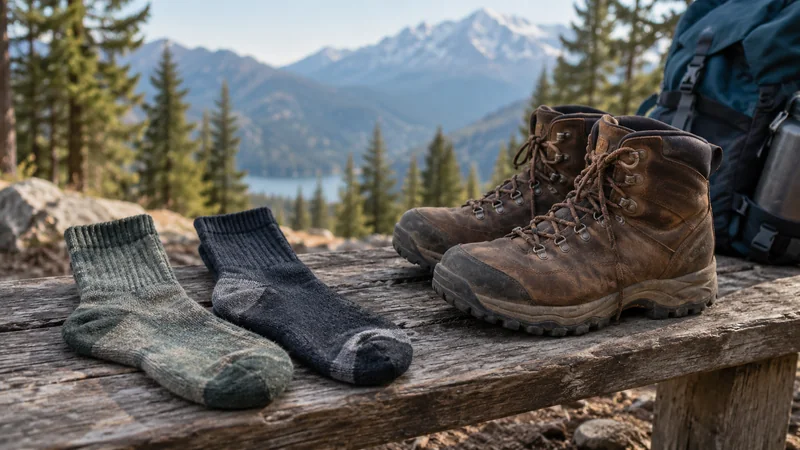
Outdoor brands in Europe and Australia often start a hiking sock project with a material question: merino, synthetic or a mix? This guide sets out what to compare before you decide. It does not replace the yarn supplier's data or a laboratory test. For the commercial route, see our outdoor and hiking socks page, and for projects that start from your own specification, custom sock development.
The fibre descriptions below are general textile tendencies, not results for a particular sock. None of our current outdoor product pages is described as a merino sock. The heather hiking style lists wool-blend yarn options, but the wool type, percentages, availability and care instructions are confirmed in the quotation and approved specification. Do not describe a product as merino until the composition is confirmed and you hold supporting yarn documentation.
1. Compare the full composition, not the headline fibre
A hiking sock blends fibres because each one does a different job. Write each option as a full composition so both samples can be compared on equal terms:
| Fibre | Commonly used for | Verify on your sample |
|---|---|---|
| Merino or other wool | Soft hand feel and absorbing moisture vapour within the fibre; often chosen for cooler-season and longer-wear ranges. | Feel, thickness, shrinkage after washing and the confirmed wool percentage. |
| Nylon (polyamide) | Strength and reinforcement, often in heel and toe areas. | Where it is placed and how the reinforced zones feel in the boot. |
| Polyester | Synthetic-led blends; low water absorption by the fibre itself. | Drying behaviour with your knit structure and hand feel against the skin. |
| Elastane | Stretch and recovery, usually a small percentage. | Cuff hold and shape recovery after wear and washing. |
General tendencies only. The same fibre can behave differently in a different yarn count, knit structure or finish.
In the brief, write each option in the form [x]% wool (state type) / [y]% polyamide / [z]% elastane or [x]% polyester / [y]% polyamide / [z]% elastane, with the brackets completed only once the yarn supplier confirms availability. If customers rule out wool entirely, see wool-free hiking socks.
2. Thickness and cushioning matter as much as fibre
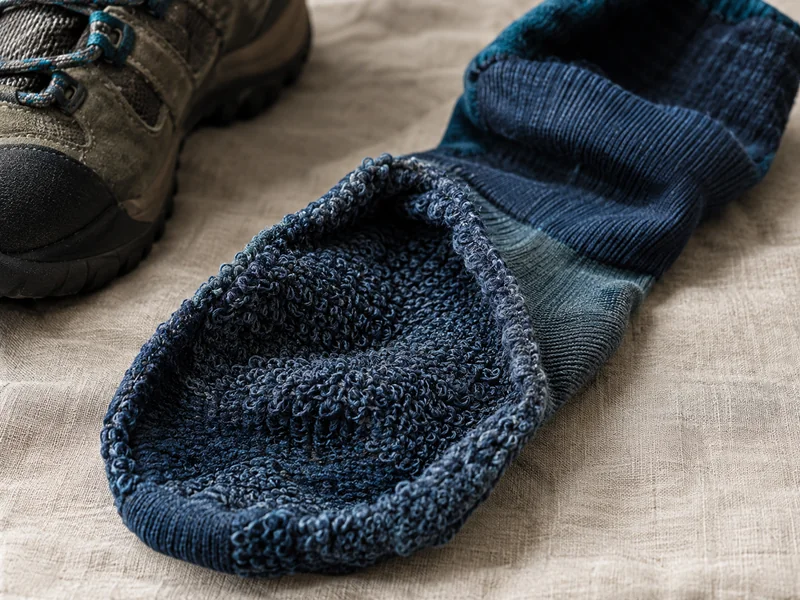
Two socks with the same composition can feel very different if one is a light, thin knit and the other has full terry cushioning. When you compare materials, keep the construction the same: same height, same cushioning zones, same size. Otherwise you will be comparing thickness, not fibre. Common outdoor builds include:
- Light cushion — padding at the heel and forefoot only, for trail shoes and warmer conditions.
- Mid cushion — a broader cushioned sole for day hiking in mid boots.
- Heavy cushion — fuller padding for colder seasons and heavier boots, using more boot volume.
3. Match the sock to the footwear and season
Name the boot, climate and activity before choosing yarn. A sock for summer trail running in Australia and a sock for winter hiking in the Alps can share a brand look but should not share every specification. On the sample, check:
- Fit inside the intended boot or shoe across the planned sizes, including toe room and heel position.
- Cuff clearance — the cuff should sit above the boot collar for the height you choose.
- Thickness in the boot after a long walk, not only when first put on.
Our three live outdoor styles are all ribbed crew designs that differ mainly in yarn appearance and pattern:
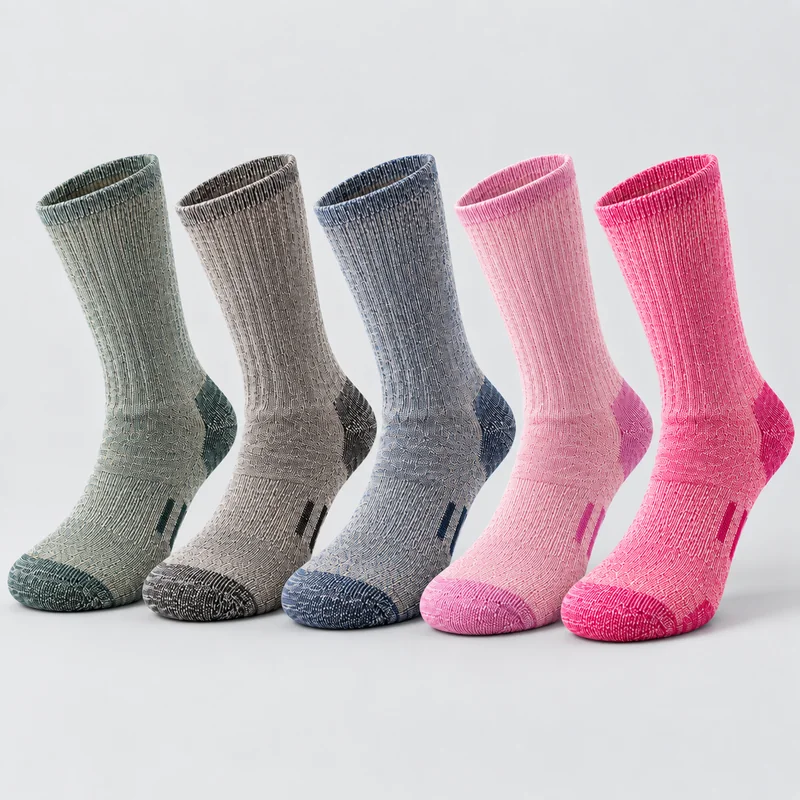
Custom Heather Hiking Socks
Heather yarn texture, ribbed crew cuffs and contrast heel and toe. Develop a winter outdoor range with custom colours, sizes and branded packaging.
View Product Details →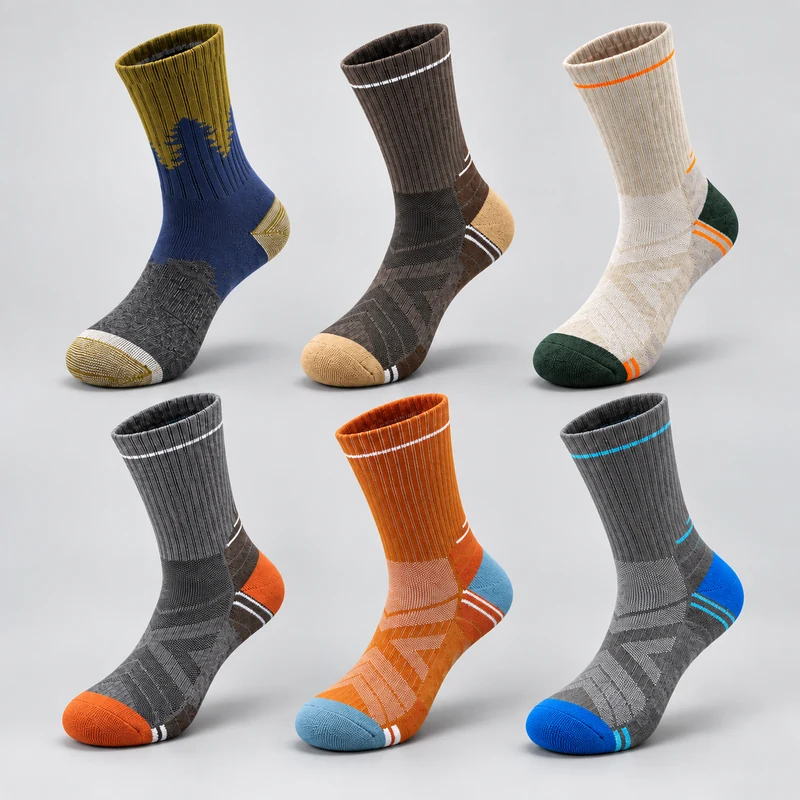
Custom Jacquard Hiking Socks
Ribbed crew cuffs, jacquard details and contrast heel and toe colours. Plan an outdoor size range and branded packaging for hiking retail or wholesale.
View Product Details →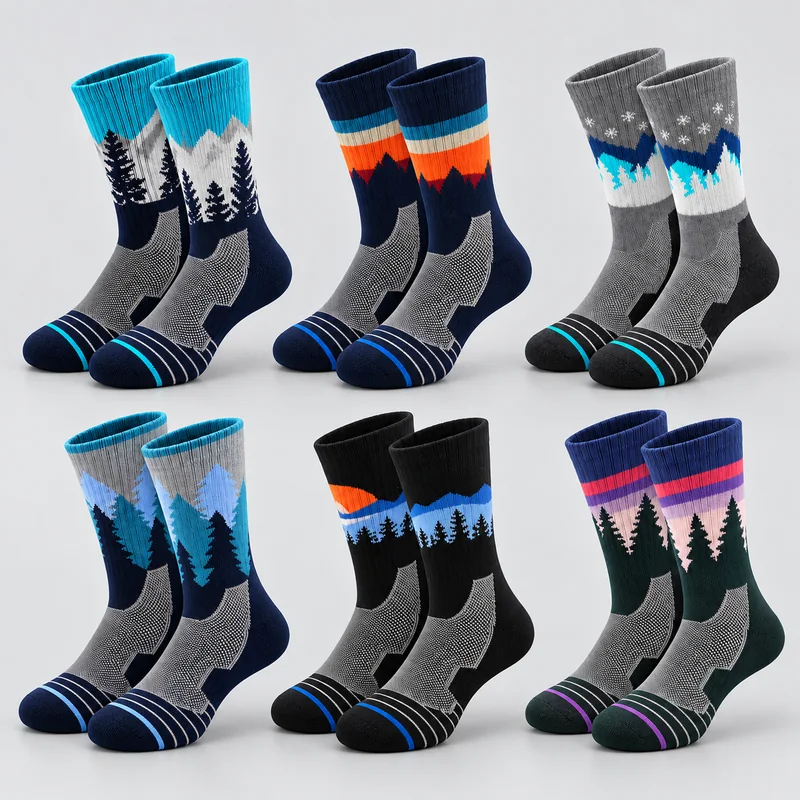
Custom Landscape Hiking Socks
Mountain and forest jacquard, ribbed crew cuffs and contrast knit zones. Develop seasonal outdoor designs with custom colours, sizes and branded packaging.
View Product Details →The heather style page lists wool-blend yarn options and cushioned heel and toe construction options. The jacquard page notes that its images do not establish a fixed wool content or fabric weight, and the landscape page confirms fibre composition and cushioning zones during quotation and sampling. In every case the composition is agreed for your order.
4. Care: write the label from the confirmed yarn
Wool and synthetic yarns can need different care, and wool behaviour also depends on any treatment applied to the yarn. Do not copy care instructions from another brand. Instead:
- Ask the yarn supplier and factory for the recommended care for the exact yarn.
- Write a proposed care label for each sample.
- Wash the samples according to that label several times.
- Compare length, width, shape, pilling and how the cuff recovers against an unwashed sample.
If you need laboratory results, washing procedures such as ISO 6330 and dimensional-change methods such as ISO 5077 are commonly referenced; agree the method with your test lab.
5. Run a drying comparison you can repeat
"Dries faster" is only meaningful against a defined method. A simple in-house comparison, using samples of the same construction and size:
- Weigh each dry sock after leaving it in the same room for a day.
- Wet both in the same way — for example, soak, then spin or press out water identically.
- Weigh again, then hang both on identical clips in the same place.
- Weigh at fixed intervals and record how long each takes to return to near its dry weight.
- Repeat at least once, swapping hanging positions.
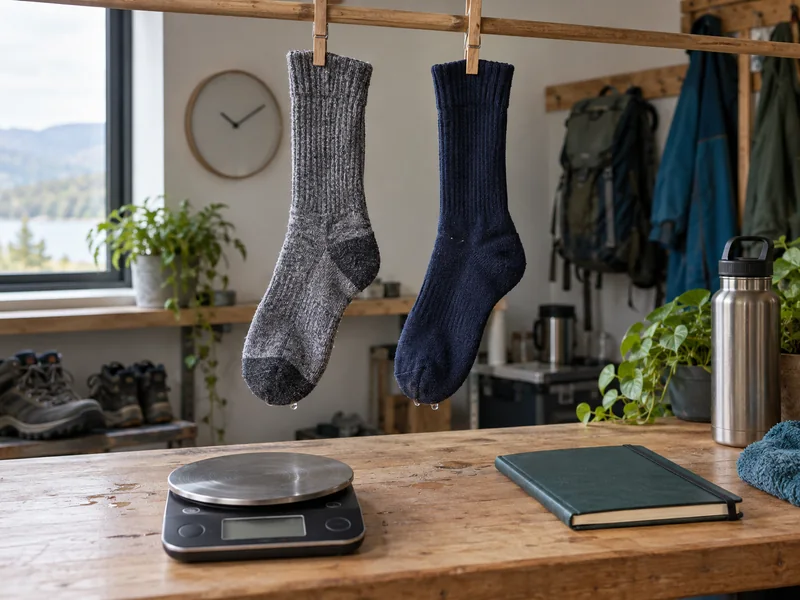
This is a comparative check under your own conditions, not a certified result. Laboratory drying-rate methods exist, such as ISO 17617 and AATCC drying-rate test methods; use an accredited lab if you plan to publish a drying claim. For an overnight, multi-day scenario, see quick-drying hiking socks.
6. Purchasing cost: compare like-for-like quotes
Wool and wool-blend yarns are generally priced differently from common synthetic yarns, and price also moves with the wool type, the blend percentage, dyeing and availability. The fair comparison is two quotations for the same construction, size range, colours and packaging, differing only in yarn. Ask for each quote to state:
- The confirmed composition and whether the yarn is available in your colours.
- Any yarn-related minimum or lead-time difference.
- Sample charges for each composition.
MOQ, sample timing and bulk timing are quoted for the selected outdoor construction; the published standard grip sock terms do not apply to hiking socks.
7. Labelling and material claims
Material names are regulated in many markets. In the EU, textile fibre names and composition labelling are governed by Regulation (EU) No 1007/2011. In Australia, textile care labelling is subject to a mandatory information standard under the Australian Consumer Law. Check the current rules for each market with your compliance adviser. In practice:
- Use fibre percentages from the confirmed specification, not from a sample description.
- Keep yarn supplier documentation for any "merino" or other wool-type claim.
- Do not use certification marks, such as wool-industry or environmental labels, unless you hold the relevant licence or certificate for that product.
- Back any functional claim — warmth, odour, drying — with an agreed test, or leave it out.
8. A brief for a material comparison
| Decision | Include in your brief | Approve on the sample |
|---|---|---|
| Use and footwear | Boot or shoe type, season, climate and market. | Fit and cuff clearance in the intended footwear. |
| Compositions | Two or more target blends written as full percentages. | Confirmed composition for the approved option, with yarn documentation. |
| Construction | Height, cushioning zones and reinforcement, identical for every composition. | Thickness and zone placement on each sample. |
| Care and drying | Proposed care label and the comparison method you will use. | Size and appearance after washing, plus your drying comparison records. |
Frequently asked questions
Is merino better than synthetic for hiking socks?
Neither is better in every case. Wool blends and synthetic blends suit different customers, seasons, care habits and price points. Compare samples of the same construction before deciding.
Are merino hiking socks 100% merino?
Hiking socks are commonly blends that include nylon for strength and elastane for stretch. State the composition you want and the factory confirms feasibility and yarn availability in the quotation.
Can your heather hiking socks be made with merino wool?
The heather hiking style lists wool-blend yarn options. The wool type, percentages and availability are confirmed in the quotation and specification; the product page does not describe the style as merino.
How should we compare drying time between two samples?
Use the same construction and size, wet both samples the same way, hang them in identical conditions and weigh them at fixed intervals. Treat it as a comparison, and use an accredited lab before publishing a drying claim.
What MOQ and lead time apply to hiking socks?
Minimums and timing depend on the yarn, construction, colour and size mix, branding and packaging. Send your quantity breakdown and target date for a project-specific quotation.
Next steps
Review the outdoor styles on outdoor and hiking socks, read how approved samples become reorder references on quality and reorders, and send your comparison brief through the quote form. For warm-weather ranges, see our guide to running socks for hot weather.