Before ordering quick-drying hiking socks, define the job: after a hiker washes and wrings the sock in the evening, it should be dry enough to wear the next morning under realistic camp conditions. Compare samples of the same size and construction with one method. Wet and wring them the same way, hang them in the same place, weigh them at fixed times and check the cushioned zones by hand. Record everything, repeat after several washes, and only use "quick-drying" on the label if you can show what it was compared with and how it was tested.
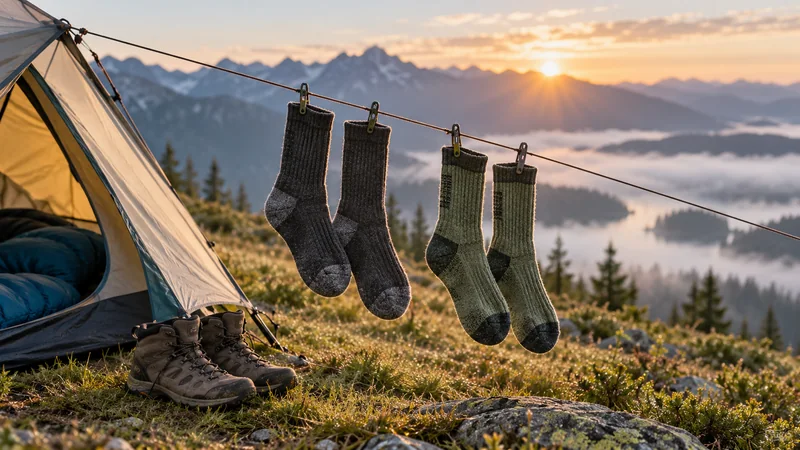
Our guide to merino vs synthetic hiking socks compares materials as a whole and includes a simple drying comparison. This guide picks up one question from it in more detail: after washing on a multi-day hike, will the sock be ready for the next use? It covers how hikers actually wash and dry socks on the trail, how to compare samples, what to record, and how to word the claim. For the product range, see outdoor and hiking socks.
We do not publish drying times or drying rates for any of our socks, and none of our product pages describes a style as quick-drying. Drying depends on the confirmed yarn, knit, thickness, how the sock was wrung out and the drying conditions. The methods below are comparison methods for your own samples, not certified results. MOQ, sample timing and bulk timing for outdoor socks are quoted per project; no universal outdoor MOQ is published.
1. Define dry enough for the next day
"Quick-drying" means little until you say quick compared with what, and dry enough for what. For a multi-day hiking sock, a useful target describes the customer's situation:
- When it is washed. Usually in the evening at camp or a hut, sometimes at a lunch stop.
- How it is dried. Hung inside a tent or vestibule overnight, on a hut drying rack, or clipped to the outside of a pack the next day.
- What "ready" means. Comfortable to put on without feeling damp, especially at the heel, toe and cushioned sole, which usually hold the most water.
- How many pairs the hiker carries. A hiker who rotates two or three pairs may only need a sock to be dry within a day on the pack, not by the next morning.
Write the target as a sentence your team can test, for example: "After hand-washing and wringing, the sock reaches no more than [x]% above its dry weight after [y] hours hung indoors at about [temperature] and [humidity], with no damp feel at the heel and toe." Complete the brackets with your own scenario before sampling, not afterwards.
2. What decides how fast a sock dries
Drying is the combined result of the sock and its surroundings. When samples dry differently, look at each factor before deciding which yarn "wins":
| Factor | General tendency | What to control in a comparison |
|---|---|---|
| Fibre | Wool and cotton absorb water into the fibre; polyester absorbs very little; nylon sits in between. | Compare full compositions, not headline fibres. |
| Thickness and cushioning | Terry loops and thicker knits hold more water and dry last. | Use the same construction and cushioning zones for every sample. |
| Size and weight | A larger sock holds more water in total. | Compare the same size, and report moisture as a percentage of dry weight. |
| Wringing | How much water is pressed out changes the starting point more than many fibre choices do. | Use one wringing method every time. |
| Air, humidity and temperature | Moving, dry, warm air dries socks fastest; a cold, humid tent dries them slowest. | Hang samples side by side in the same place and record the conditions. |
General textile tendencies, not results for a particular sock. A blend can behave differently from its main fibre.
The fibre choice itself is covered in the merino vs synthetic guide. If your customers have ruled out wool altogether, see what to specify for wool-free hiking socks.
3. How hikers wash and dry socks on the trail
Your comparison should copy what customers actually do, not a laundry machine. On a multi-day trip, socks are usually rinsed or hand-washed in a small amount of water, wrung out by hand and hung up. Two points are worth including in your care guidance:
- Wash away from water sources. Leave No Trace advises carrying water about 200 feet (roughly 60 metres) away from streams or lakes to wash, and using only small amounts of biodegradable soap (Leave No Trace, Principle 3).
- Keep socks away from strong heat. Drying socks next to a stove or fire can damage synthetic fibres or shrink wool. Advise airflow rather than heat.
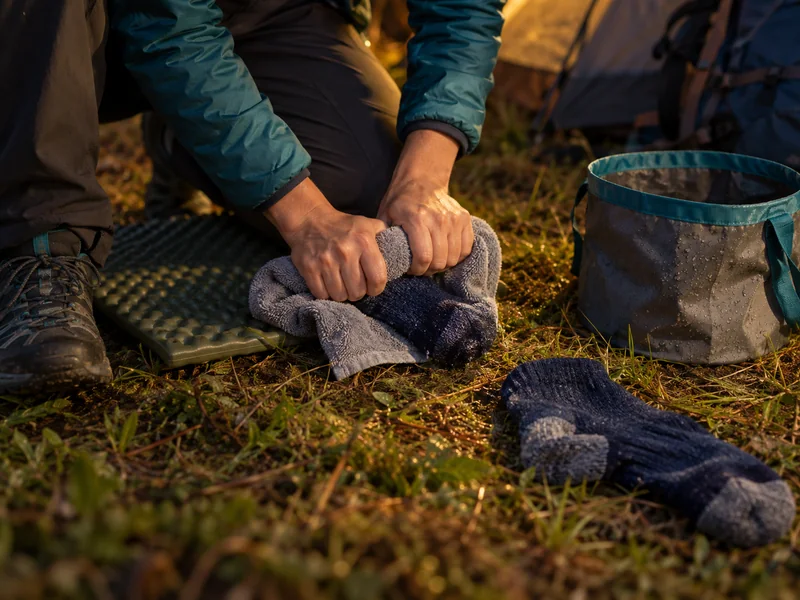
A simple field technique also helps every sock dry faster: wring the sock, roll it tightly in a small towel or a dry shirt, press, then hang it inside out where air can move. If your care card recommends this, use the same technique in your sample comparison.
4. Compare samples with one method
Keep everything the same except the thing you are comparing: usually the composition, sometimes the construction. A practical comparison for a multi-day scenario:
- Prepare matched samples. Same size and construction, labelled with a sample code. Wash each sample once according to the proposed care label before the first test.
- Weigh dry. Leave the samples in the same room for a day, then record the dry weight of each.
- Wet and wring the same way. Soak each sample for the same time, then remove water with one fixed method, for example the towel roll described above with the same towel and pressure. Record the wet weight.
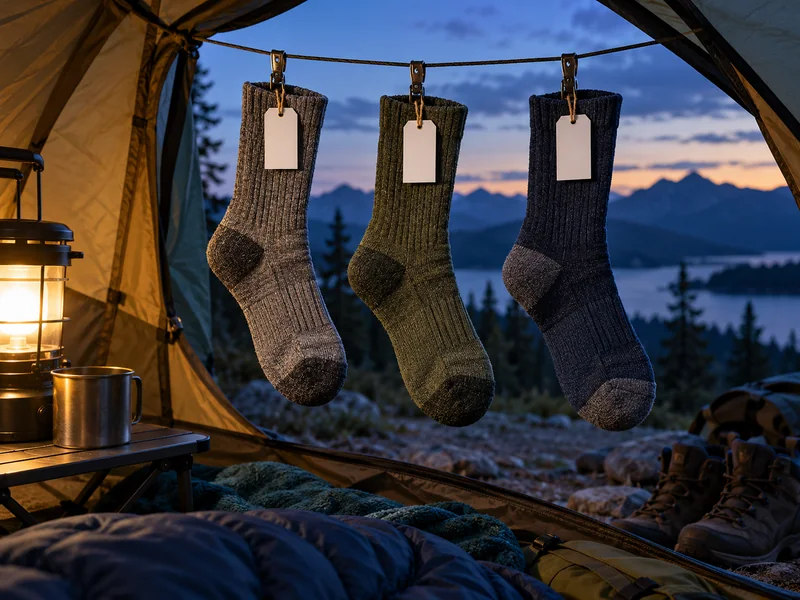
- Hang in your scenario. Side by side on identical clips, inside out or right side out but the same for all, in conditions that match your target: a tent overnight, a cool hut, or a warm room. Record temperature and humidity if you can.
- Weigh at fixed times. For example after 1, 2, 4 and 8 hours, and the next morning. Calculate moisture above dry weight: (current weight − dry weight) ÷ dry weight × 100.
- Do a next-morning feel check. Put each sample on and note any damp feel at the heel, toe and sole.
- Repeat. Run the comparison at least twice, swapping hanging positions, and again after several washes, because the knit surface can change with use.
This approach extends the simple drying comparison in the materials guide to a realistic overnight scenario.
5. Keep a drying record you can show later
If the result will support a product decision or a claim, record it in a form someone else can check. Fields worth including:
| Record | What to write down | Why it matters |
|---|---|---|
| Sample identity | Sample code, revision date, confirmed composition, construction, size. | Links the result to one exact version. |
| Preparation | Washes before testing, care method used. | New and washed socks can behave differently. |
| Wetting and wringing | Soak time, wringing method, dry and wet weights. | Shows that every sample started the same way. |
| Conditions | Location, temperature, humidity, airflow, start time. | Results only apply to the conditions tested. |
| Results | Weights at each time, moisture above dry weight, next-morning feel. | The evidence behind any decision. |
| Tester and repeats | Who ran it, how many repeats, any changes. | Shows whether the result is consistent. |
6. When to use a laboratory method
An in-house comparison is enough to choose between samples. If you plan to publish a drying claim, or a retailer asks for a test report, use an accredited laboratory and agree the method in advance. Common published methods include:
- ISO 17617: Textiles: Determination of moisture drying rate. It is designed for textile fabrics, not loose fibre or yarn.
- AATCC TM199: Drying Time of Textiles: Moisture Analyzer Method.
- AATCC TM200: Drying Rate of Textiles at their Absorbent Capacity: Air Flow Method.
- AATCC TM201: Drying Rate of Fabrics: Heated Plate Method.
Results from different methods cannot be compared with each other, and a laboratory result describes laboratory conditions, not a cold tent. Ask the lab whether it will test finished socks or knitted panels, and whether cushioned zones are included. Then use one method consistently.
7. How to word a drying claim
"Quick-drying" is an objective claim about the product. In the US, the FTC expects advertisers to hold a reasonable basis for objective claims before they are made (FTC Policy Statement Regarding Advertising Substantiation), and other markets have similar expectations. Check the rules for each market with your adviser. In practice:
| Approach | Example | Evidence needed |
|---|---|---|
| Describe the build | "[Composition] blend with a light-cushion sole and mesh instep." | The confirmed specification. |
| Qualified comparison | "Dried faster than our [reference sock] in [method] testing." | A test record using that method and that reference. |
| Unqualified absolute | "Dries overnight." "Always dry by morning." | Hard to support because conditions vary; avoid. |
| Implied health benefit | "Prevents blisters because it dries fast." | A different, stronger kind of claim; leave it out. |
Example clauses with fields to complete. Not legal advice; confirm wording for each market.
8. Our outdoor styles and the composition you choose
Our listed outdoor styles are design references. Their yarn composition, thickness and cushioning are confirmed for each order, so drying behaviour depends on the specification you agree:
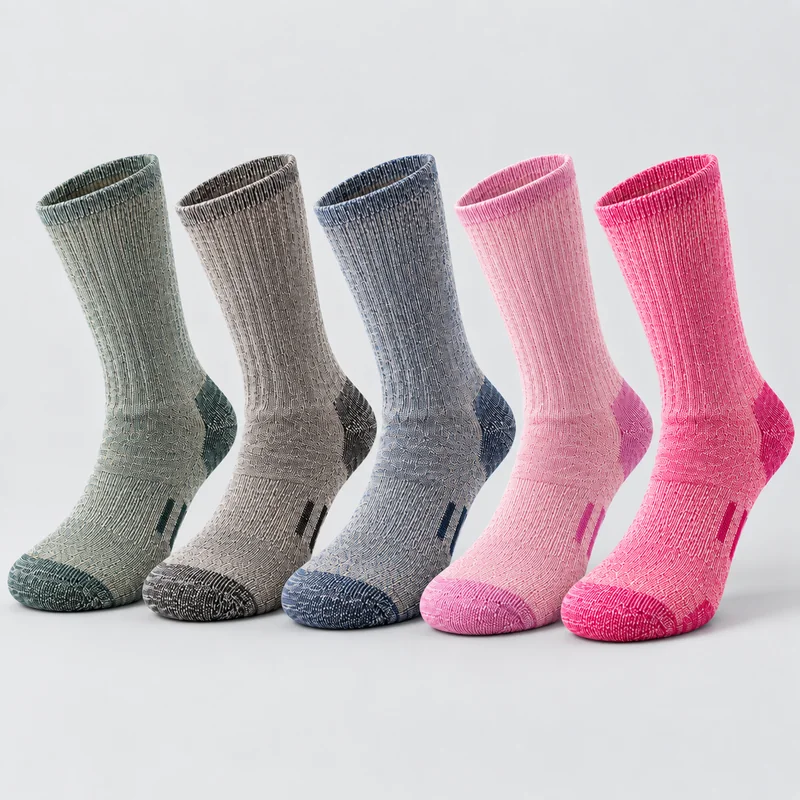
Custom Heather Hiking Socks
Heather yarn texture, ribbed crew cuffs and contrast heel and toe. Develop a winter outdoor range with custom colours, sizes and branded packaging.
View Product Details →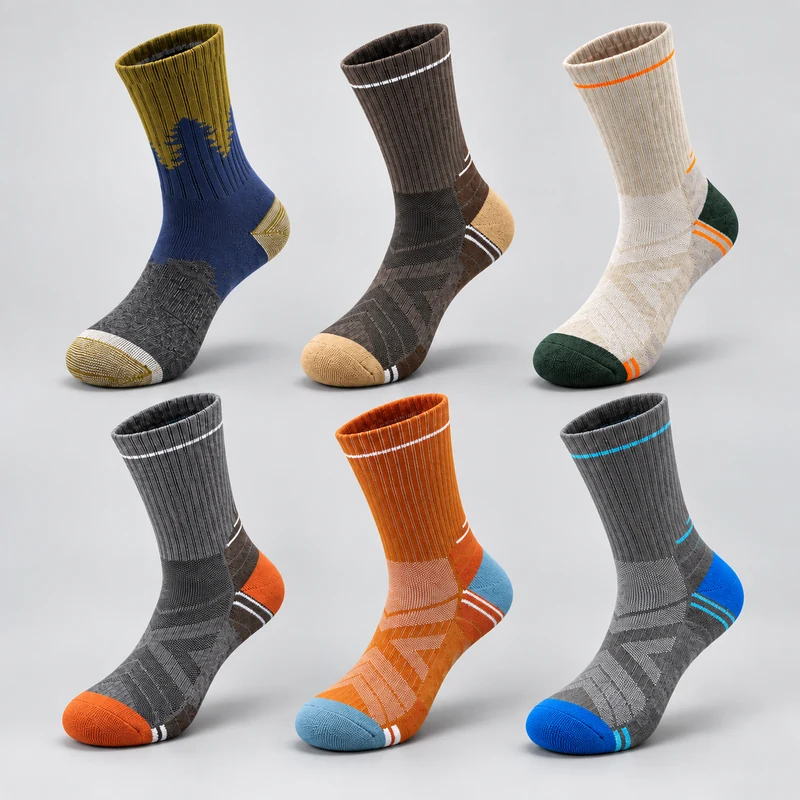
Custom Jacquard Hiking Socks
Ribbed crew cuffs, jacquard details and contrast heel and toe colours. Plan an outdoor size range and branded packaging for hiking retail or wholesale.
View Product Details →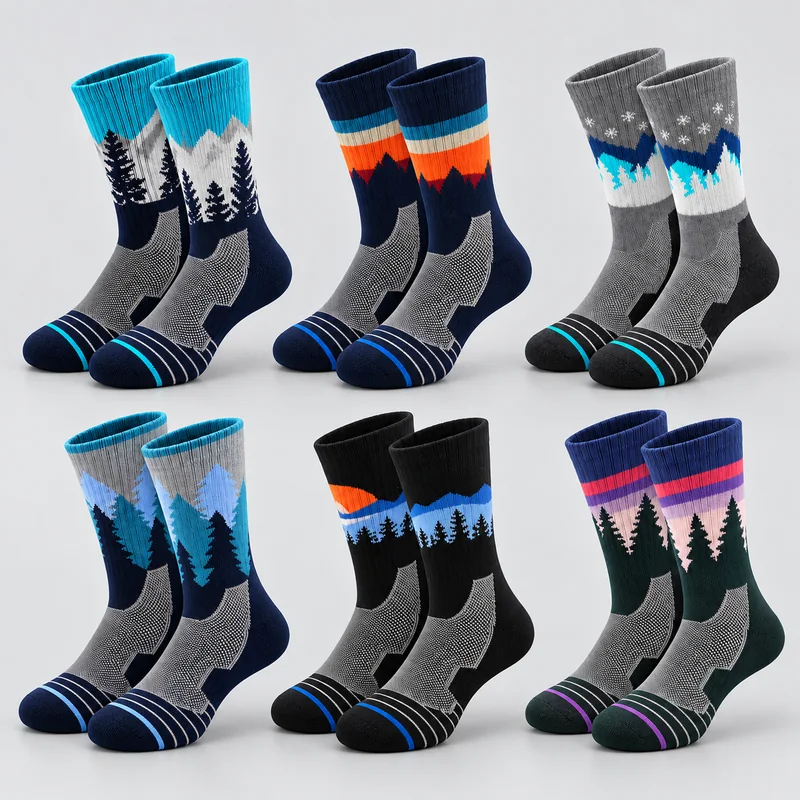
Custom Landscape Hiking Socks
Mountain and forest jacquard, ribbed crew cuffs and contrast knit zones. Develop seasonal outdoor designs with custom colours, sizes and branded packaging.
View Product Details →If drying is a priority, say so in the brief together with your target scenario, and request two or more compositions on the same construction for comparison. A new combination of yarn and construction is handled through custom development.
9. Keep the result valid for reorders
A drying result belongs to one yarn and one construction. A change of yarn supplier, yarn count, knit density or finish can change it. Record the confirmed composition and construction with the approved sample, keep the drying record with the specification, and decide in advance whether a specification change needs the comparison to be repeated. Our quality and reorders page recommends confirming whether an agreed test is needed again after a specification change.
Frequently asked questions
What makes a hiking sock quick-drying?
Drying depends on the fibre blend, the thickness and cushioning, how much water is wrung out and the drying conditions. Compare samples of the same size and construction with one method rather than relying on the fibre name alone.
Are synthetic hiking socks always faster drying than wool?
Not always. Polyester absorbs little water into the fibre, but a thick cushioned synthetic sock can still hold more water than a thin wool-blend sock. Compare finished samples.
How can we test drying without a laboratory?
Weigh matched samples dry, wet and wring them the same way, hang them side by side in your target conditions and weigh them at fixed times. Calculate moisture above dry weight and repeat the test. Treat it as a comparison, not a certified result.
Can we call our hiking socks quick-drying?
Only with evidence for the claim as worded. Describe the build factually, or use a qualified comparison backed by a test record. Avoid unqualified promises such as dries overnight.
Do your outdoor socks have a published drying time?
No. We do not publish drying times or rates. Yarn, thickness and cushioning are confirmed for each order, and any test is agreed for the project.
Next steps
Review the styles on outdoor and hiking socks, compare materials in our merino vs synthetic guide, and send your target scenario and compositions through the quote form.