Selling grip socks at a Pilates studio is worth it when each pair contributes enough after every cost. That means the sock, packaging, freight, duties, payment fees and an allowance for pairs lost or given away. Calculate contribution per pair, then the number of pairs you need to sell to recover one-off costs. Reorder each size when its stock falls to the pairs you expect to sell before the next delivery arrives, plus a buffer. Use your own quotes and sales figures; the numbers in this guide are assumptions.
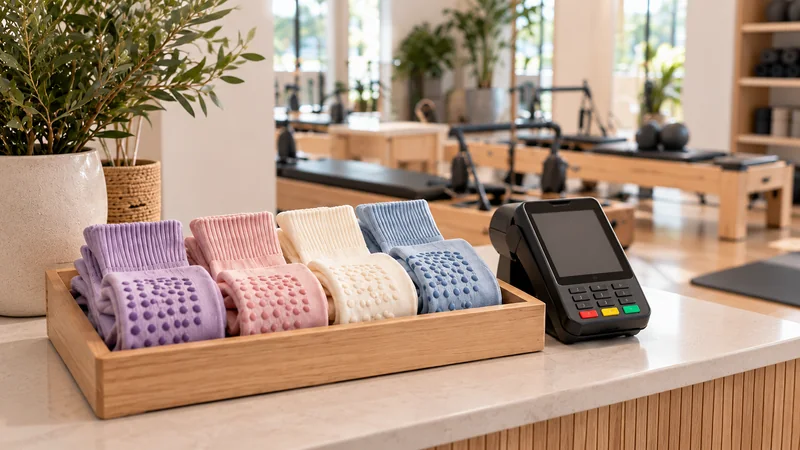
Our guide to planning a studio's first grip sock order covers what to buy first: styles, colours and sizes. This guide covers the next question: once the socks are on the shelf, do they pay for themselves, and when should you reorder? Our studio program page includes a gross-margin calculator per pair. Here we go one step further and add the costs that calculator leaves out on purpose: payment fees, shrinkage and operating time.
We do not publish sock prices, freight rates, retail prices or margins. Every figure in the worked example is an assumption chosen to show the arithmetic; it is not a quotation, a price we charge, a recommended retail price or a typical result. The only published quantity rule used here is for standard grip styles: a minimum of 50 pairs per style, per colour and per size. Other constructions, embroidery, special grip requirements and custom packaging are quoted separately.
1. Start with the landed cost per pair
The price on a factory quotation is only part of what a pair costs you by the time it is on the front desk. Build the landed cost line by line, in one currency, excluding any sales tax or VAT you can recover:
| Cost line | Where the figure comes from | Per pair |
|---|---|---|
| Sock price | The factory quotation for your style, colours and sizes. | [sock price] |
| Packaging | Bands, hangtags or bags, if quoted separately. | [packaging] |
| Freight | The freight quote ÷ the pairs in the shipment. | [freight] |
| Duties and import charges | Your customs broker or carrier, for your destination. | [duties] |
| One-off costs, spread | Sample, setup or artwork charges ÷ the pairs you expect to sell. | [one-off ÷ pairs] |
Add the lines to get the landed cost per pair. Ask for each cost as a separate line when you request a quote, so different suppliers or order sizes can be compared on the same basis. Our studio page recommends the same: sock price, packaging, sample or setup charges, freight and destination charges listed separately, with consistent quantities, currency and tax treatment. For deliveries to the US, UK, Europe or Australia, see the international order brief for what to include.
2. Add the costs that come with each sale
Some costs only appear when a pair is sold:
- Payment fees. Card and booking-platform fees are usually a percentage of the sale, sometimes plus a fixed amount per transaction. Use the rate on your own provider's statement or price page, because rates differ by provider, plan, country and card type.
- Sales tax or VAT. If your selling price includes tax you must pay on, calculate margins on the price excluding tax.
- Bundle discounts. If socks are sold at a lower price inside a class pack or membership offer, use that lower price for those pairs.
3. Allow for shrinkage, giveaways and staff use
Not every pair you receive will be sold at full price. Decide in advance how you will treat:
- Complimentary pairs for new members, trial classes or instructors.
- Class-use pairs taken from retail stock when a member forgets their own socks.
- Lost, damaged or display pairs that cannot be sold.
- End-of-season colours sold at a discount.
The simplest approach is a shrinkage allowance: the share of pairs you expect not to sell at full price, based on your own records. Spread its cost across the pairs you do sell. If you already know giveaways will be a large share, consider ordering those pairs as a separate class-use or member-pack line, which our studio page treats as a different stock route from reception retail.
4. Set a selling price and check the margin
Two ratios are commonly used, and they are easy to confuse:
- Gross margin = (selling price − landed cost) ÷ selling price × 100. This matches the formula in our studio calculator.
- Markup = (selling price − landed cost) ÷ landed cost × 100.
A 50% gross margin is a 100% markup, so state which one you mean when you discuss pricing with staff or partners. Set the price from what your members expect to pay at your studio and nearby, then check the margin. If the margin is too thin, adjust the order (pack format, freight basis or quantities) rather than only the price.
5. From gross margin to contribution per pair
Gross margin ignores fees and shrinkage. Contribution per pair is closer to what each sale actually adds:
- Net selling price = selling price (excluding tax) − payment fees on that sale.
- Shrinkage cost per sold pair = landed cost × shrinkage allowance ÷ (1 − shrinkage allowance).
- Contribution per pair = net selling price − landed cost − shrinkage cost per sold pair.
- Pairs to recover one-off costs = one-off costs ÷ contribution per pair, if you did not already spread them in the landed cost.
Contribution is still not profit. Staff time at the desk, display space, card readers and stock counting are real costs too. Decide whether the socks are expected to make money on their own, or mainly to serve members who need grip socks for class.
6. A worked example with assumed figures
The figures below are invented to show the arithmetic. They are not our prices, a typical retail price or a forecast. Replace every value with your own quotations and records.
| Line (assumed values) | Calculation | Result |
|---|---|---|
| Landed cost per pair | Assumed sock 4.00 + packaging 0.40 + freight and duties 1.10 + one-off costs spread 0.50 | 6.00 |
| Selling price (excluding tax) | Assumed | 18.00 |
| Gross margin | (18.00 − 6.00) ÷ 18.00 | 66.7% |
| Payment fees | Assumed 3% of 18.00 | 0.54 |
| Shrinkage cost per sold pair | Assumed 5% allowance: 6.00 × 0.05 ÷ 0.95 | 0.32 |
| Contribution per pair | 18.00 − 0.54 − 6.00 − 0.32 | 11.14 |
All values are assumptions in a single, unnamed currency, chosen only to make the arithmetic visible. They are not a quotation, a price we charge, a recommended retail price or an expected margin.
In this example, the gross margin looks like two-thirds of the price, but each pair contributes a little under 62% of the selling price once fees and shrinkage are included. That gap is why the extra lines matter. In your own figures, freight per pair can change more than any other line, so check it for the order size you actually plan.

7. Set a reorder point for each size
Studios rarely run out of every size at once; one or two sizes usually go first. Set a reorder point for each style, colour and size line:
- Weekly sales per line. Average pairs sold per week over the last several weeks, from your till or booking system.
- Lead time in weeks. From placing the reorder to stock arriving at the studio: production, packing, transport and receiving. Confirm current production and transport timing in each quotation; production working days are not an arrival date.
- Safety stock. Extra pairs to cover a busy month or a late delivery, for example one or two weeks of sales.
- Reorder point = weekly sales × lead time in weeks + safety stock.
- Order quantity. Enough to cover the weeks until the following reorder, and at least the minimum for that line. For standard grip styles, the minimum is 50 pairs per style, per colour and per size.
When a line's stock reaches its reorder point, send the reorder with the approved sample reference, quantities per line, destination and target arrival date. Our quality and reorders page explains how the approved version is kept as the reference for every repeat order.

8. What to do with slow lines
If a line takes much longer to sell than the others, the per-line minimum may be too large for its demand. Options, roughly in order of cost:
- Move slow pairs into class-use or member packs, and count them as shrinkage.
- Drop the line from the next reorder and keep it only while stock lasts.
- Replace a slow colour with a seasonal colour on the same approved construction.
- Combine sizes into wider bands at the next sample stage, so the order has fewer lines. Our size range guide explains the trade-offs.
9. Several studios or a wholesale route
If you run several locations, calculate reorder points per site and decide whether stock is delivered centrally or to each studio. The extra handling changes the freight line. If you also supply other studios or retailers, the costs and pack formats change again. Our wholesale and distribution page covers planning by channel, separating core sellers from seasonal colours, and keeping approved pack formats for reorders.
Frequently asked questions
Is selling grip socks at a Pilates studio profitable?
It depends on your landed cost, selling price, payment fees, shrinkage and sales rate. Calculate contribution per pair with your own quotations and records; there is no general margin that applies to every studio.
What is the difference between margin and markup?
Gross margin divides the profit per pair by the selling price; markup divides it by the cost. A 50% gross margin equals a 100% markup.
What should a landed cost per pair include?
The sock price, packaging, freight, duties and import charges for your destination, plus any sample, setup or artwork charges spread across the pairs you expect to sell. Exclude any sales tax or VAT you can recover.
When should a studio reorder grip socks?
Reorder each line when its stock falls to weekly sales multiplied by the lead time in weeks, plus a safety buffer. Confirm current production and transport timing with each quotation.
Do you publish wholesale prices for studio grip socks?
No. Prices depend on the style, quantities per line, branding, packaging and destination, and are quoted for each order with the main cost lines shown separately.
Next steps
Plan the opening range with our first studio order guide, try your own figures in the calculator on the studio program page, and request a quote with separate cost lines through the quote form.