Ankle and low-cut running socks show little or no sock above the shoe and suit customers who want a minimal look. Crew running socks cover the ankle and lower calf, which leaves more visible area for logos and colour and appeals to customers who want the sock to be seen. Choose by your customers' shoes, runs and style, not by a general rule. Launch one main height first. Our running range currently has low-cut, ankle-tab and knee-high styles; a crew running sock would be a custom development project.
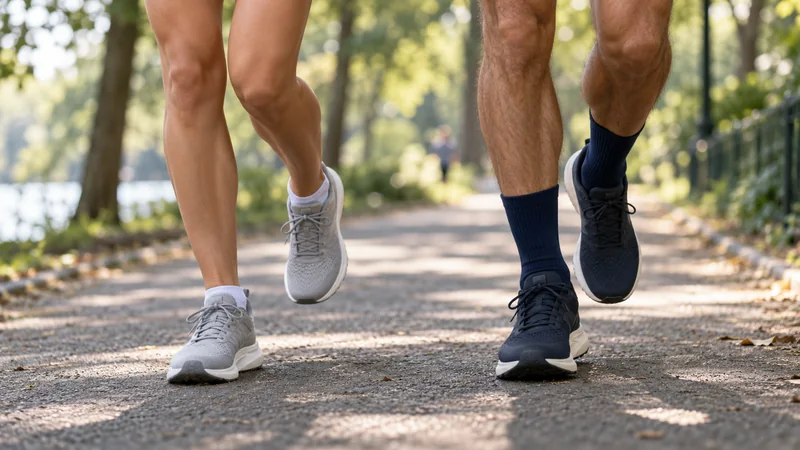
This guide is for running brands, clubs, events and retailers deciding which sock heights to sell. It covers height only. For thickness, cushioning and mesh in warm conditions, see our guide to running socks for hot weather. For the range itself, see running and training socks.
Height changes fit, appearance and branding space. We do not claim that any height prevents blisters, improves performance or provides support or compression. Running sock MOQ and lead time are quoted for each construction; the published 50-pair standard grip minimum does not apply by default. We do not currently list a crew running sock, so this guide does not describe one as available.
1. The running sock heights
Names vary between brands, so agree the height by measurement, as you would for cycling sock cuff height. As a general guide:
| Height | Where the cuff sits | What customers see with shoes on |
|---|---|---|
| No-show / low cut | Below or at the ankle bone, close to the shoe collar. | Little or no sock. |
| Ankle with heel tab | Low at the sides, with a raised tab at the back above the shoe collar. | A small strip of sock and the tab. |
| Quarter | Just above the ankle bone. | A short band of sock around the ankle. |
| Crew | On the lower calf. | A clear area of leg: room for colour, stripes and logos. |
| Knee-high | Below the knee. | Most of the lower leg. |
General descriptions. Exact heights are agreed in the specification and checked on samples.
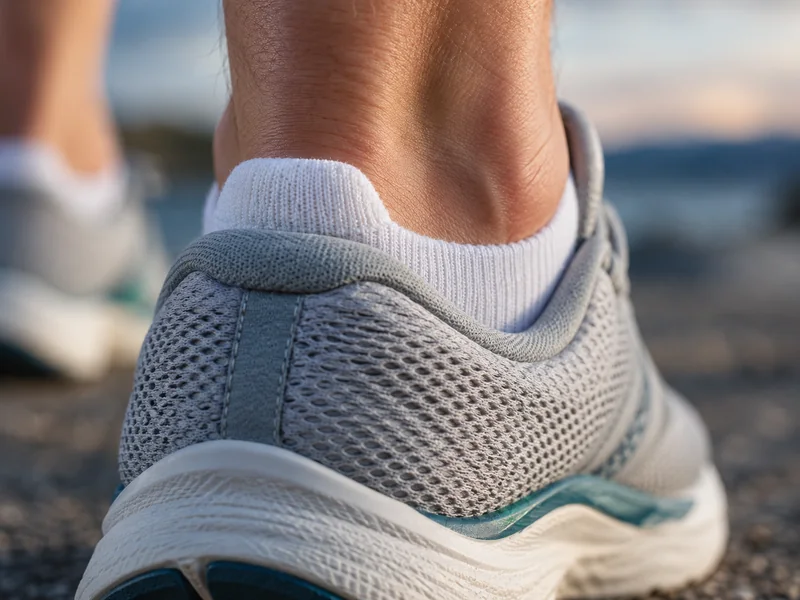
2. Shoe-collar contact
The shoe collar is the padded opening around the ankle. It is where height makes the most practical difference:
- Low-cut socks sit close to the collar. Check that the cuff stays above the back of the collar while running and does not slip down into the shoe.
- Ankle socks with a heel tab place a raised tab between the collar and the back of the ankle. Check that the tab is tall enough for the shoe heights in your range.
- Crew socks cover the ankle well above the collar, so the collar meets the sock rather than skin. Check that the extra fabric does not bunch at the front of the ankle.
Collar heights differ between road shoes, trail shoes and racing shoes. Test samples in the shoe models your customers actually wear.
3. Customer preference and appearance
Preferences for sock height vary by market, age group, season and running style, and they change over time. We will not tell you which height is "in". Use evidence from your own customers instead:
- Sales of each height if you already sell socks or apparel.
- What your club members or event entrants wear at your own events.
- A short survey or sample showing to target customers before ordering.
- Whether your shorts, tights and shoes are styled to show or hide the sock.
Seasonality matters too. A brand selling into both hemispheres may sell low-cut socks in one market's summer and taller styles in the other market's winter at the same time.
4. Space for branding and pattern
Height decides where your branding will actually be seen:
- Low-cut and ankle styles: the visible area is small and mostly at the back and sides of the cuff, plus a heel tab if there is one. Logos on the top of the foot are usually hidden by the shoe.
- Crew styles: the leg above the shoe is visible from the side and the back, so stripes, colour blocks and logos can be seen while running.
- Knee-high styles: the largest canvas, with leg panels and contrast trims.
For a club or event sock where the logo should appear in photos, a taller cuff gives more visible space. For a technical or minimal look, a low-cut sock with a small mark on the tab may be enough. Check logo legibility at knitted scale on the smallest size.
5. Match the height to the use
| Use | Heights often considered | Check on the sample |
|---|---|---|
| Road running | Low cut, ankle tab, crew | Cuff position at the collar during a normal run. |
| Trail running | Ankle tab, quarter, crew | Cover above the collar in trail shoes, and fit with gaiters if customers use them. |
| Gym and training | Low cut, ankle, crew | Fit in training shoes and appearance with gym wear. |
| Club and event socks | Crew, quarter | Logo visibility from the side and back. |
| Cooler months | Crew, knee-high | Leg length and calf fit, especially for knee-high styles. |
Typical considerations, not rules. Your customers' shoes and preferences decide the final choice.
6. What our running range covers today
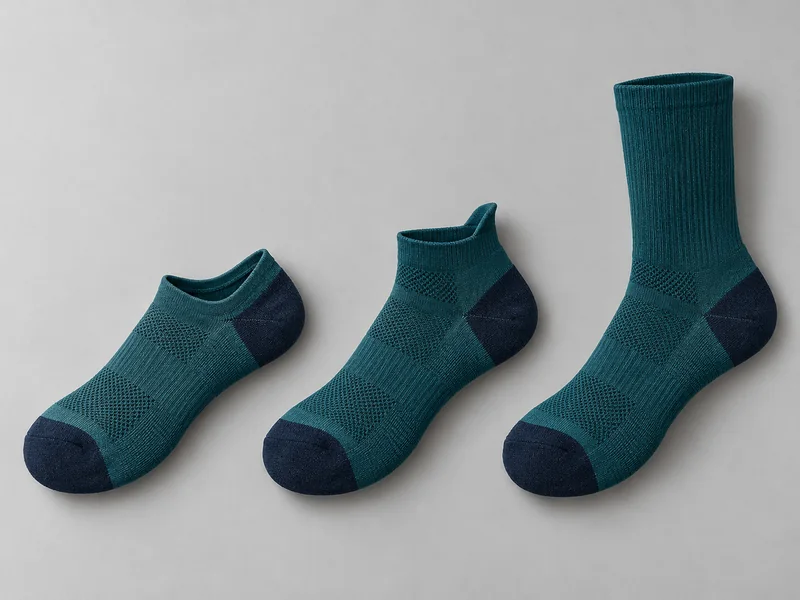
The running category currently shows two low-profile styles and one tall style:
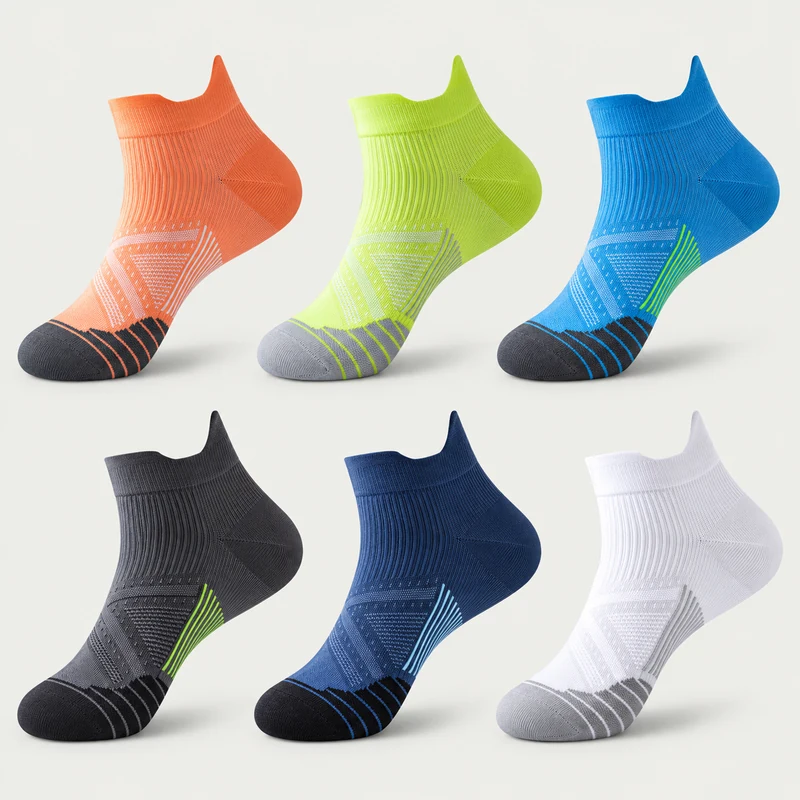
Custom Ankle Tab Running Socks
Low-cut silhouette, raised heel tab and mesh knit zones. Explore six shown colourways with custom sizing, branding and packaging options.
View Product Details →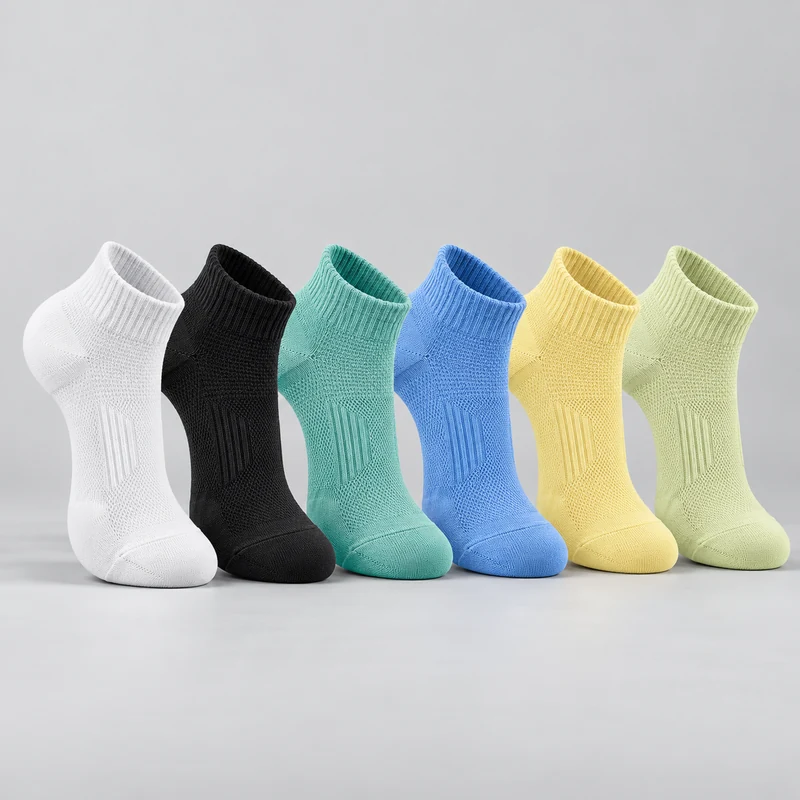
Custom Low-Cut Mesh Running Socks
Plain low-cut cuff, mesh-knit body and ribbed arch section. Plan core colours, seasonal shades, sizes and private label packs.
View Product Details →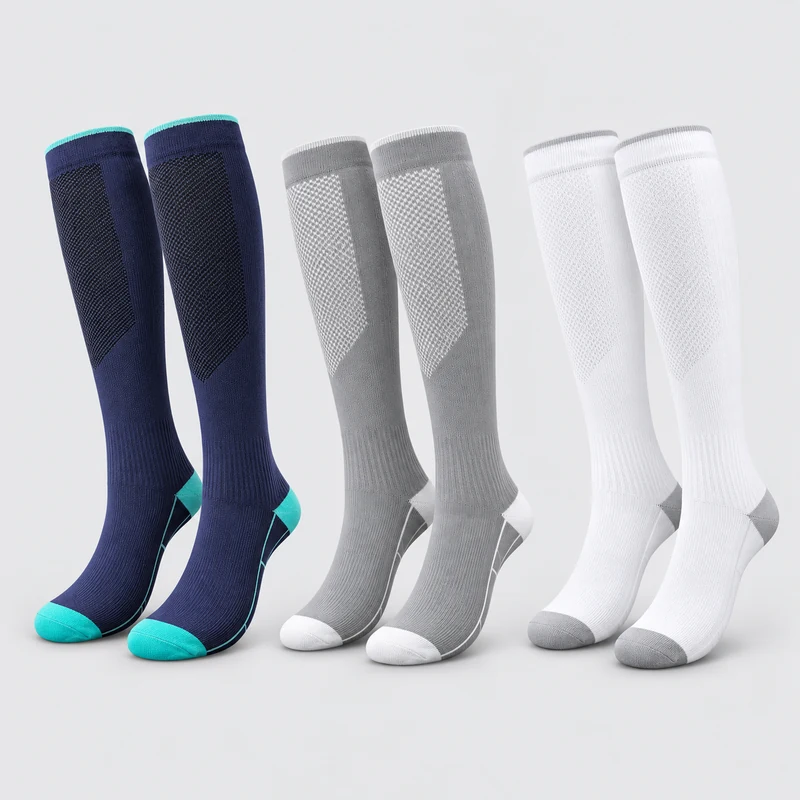
Custom Knee-High Running Socks
Knee-high profile, mesh-knit leg panels and contrast heel and toe details. Plan coordinated colours, calf fit, sizes and branded packaging.
View Product Details →The ankle-tab style has a low-cut profile with a raised heel tab. The low-cut mesh style has a plain low-cut ribbed cuff. The knee-high style has mesh-knit leg panels and contrast trims.
Crew running socks are not a listed running style. If your range needs one, it would be developed through custom development. A crew sports reference on that page, the cushioned mesh crew sports sock, shows mesh and rib zones, a cushioned sole direction and contrast heel and toe. It is a custom development reference rather than a running product, and its yarn, fit and specification are confirmed during sampling:
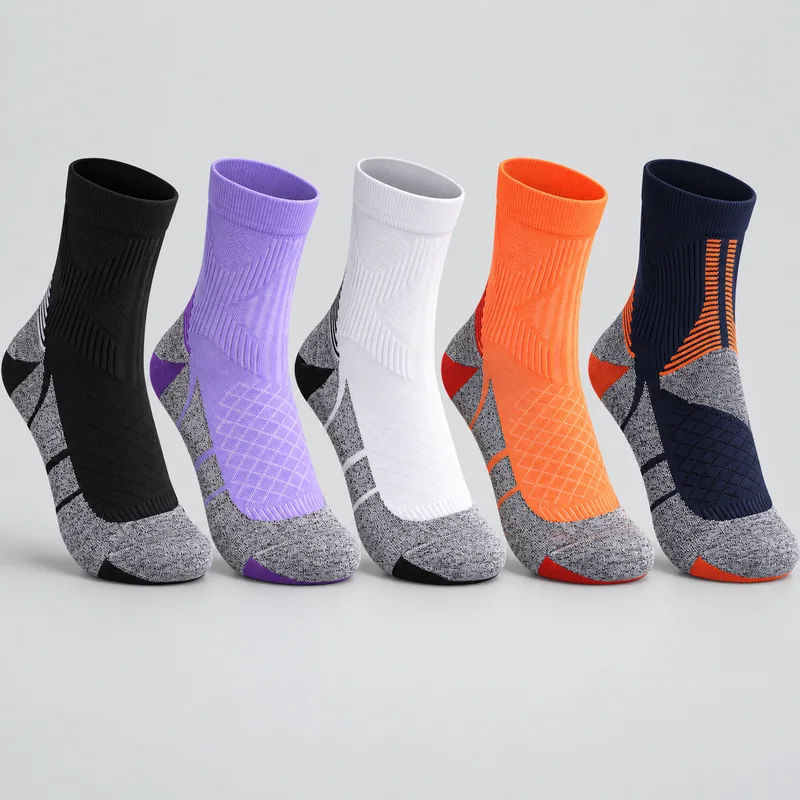
Custom Cushioned Mesh Crew Sports Socks
Mesh-knit crew sports socks with ribbed panels, a cushioned sole and five colourway references. Develop your fit, knit structure, branding and packaging.
View Product Details →7. Which heights to launch first
Every height is a separate specification, with its own sample, size lines and reorder record. A practical sequence for a new running range:
- Choose one main height based on your customers' shoes, runs and style.
- Approve it fully: fit, cuff position, colours, logo and pack.
- Launch with core colours and track sales by size.
- Add a second height when customers ask for it or sales show a gap. A low-cut range might add crew for club and event orders, for example.
- Keep the brand system the same across heights: colours, logo placement logic and packaging.
Each additional height multiplies lines by the number of colours and sizes. Our guide to planning a first sock range shows how to count lines before you commit.
8. Sample checklist for a height decision
| Decision | Include in your brief | Approve on the sample |
|---|---|---|
| Height | Reference style or flat cuff measurement per size. | Flat measurements and worn cuff position in the intended shoes. |
| Collar fit | Shoe models, and road, trail or gym use. | Cuff or tab position at the collar during a run. |
| Branding | Logo artwork, stripe or colour-block positions. | What stays visible above the shoe, and legibility on the smallest size. |
| Sizes | Size bands and markets. | Fit at both ends of each band, and calf fit for taller styles. |
| Quantities | Pairs per height, colour and size. | The quotation for each height's construction. |
Frequently asked questions
Are ankle or crew socks better for running?
Neither is better for every runner. Ankle and low-cut socks give a minimal look; crew socks cover the ankle above the shoe collar and show more of the sock. Choose by your customers' shoes, runs and style, and confirm on samples.
Do crew running socks prevent blisters?
We do not make that claim. Blisters depend on many factors, including shoes, fit, moisture and the individual runner. Height changes how the sock meets the shoe collar, which you can check on samples.
What is a heel tab on a running sock?
A raised section at the back of a low-cut or ankle sock that sits above the shoe collar. Our ankle-tab running style uses this construction.
Do you make crew running socks?
Crew is not a listed running style at the moment. A crew running sock can be developed through our custom development route, with yarn, cushioning, height and fit agreed on samples.
Should a new brand launch more than one sock height?
Many brands start with one main height and add a second once sales show demand. Each height needs its own sample, size lines and quotation.
Next steps
Compare the current styles on running and training socks, see crew references on custom development, then send your height brief through the quote form.