Seasonal sock collection planning starts with a date: when must stock be on the shelf in each market? Australia's seasons are roughly six months out of step with Europe, the UK and North America. One approved construction can therefore serve both, with separate launch dates and colour stories. For each launch, work backwards: receiving and buffer, freight, bulk production, approvals, sampling and the brief. Use only confirmed timings from quotations and your forwarder. Production working days are not an arrival date.
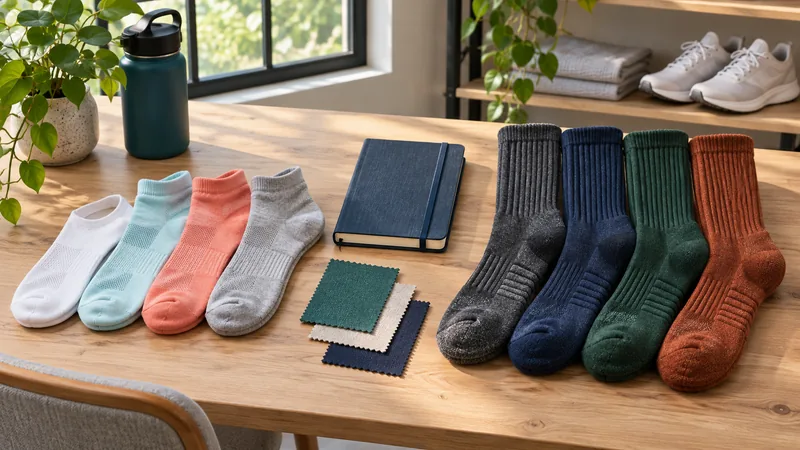
This guide is for brands, distributors and clubs that sell sports socks in more than one hemisphere, or that supply retailers with fixed seasonal windows. It covers the calendar, the backward timeline, the buffers worth keeping and how to reuse one approved product across markets. For quantities and minimums, see Samples & MOQ; for building a multi-channel assortment, see wholesale and distribution.
The only published timings are for standard grip styles: samples in 10–15 working days and bulk production in 12–16 working days, counted from confirmed starts. Running, cycling, outdoor and other constructions are quoted for their own timing. We do not publish transit times or delivery dates, and products are made by Haiyan Huaerte Knitting Co., Ltd. in Zhejiang, China; no US, UK, European or Australian warehouse stock is represented. Any durations shown as [fields] are for you to complete from your own quotations.
1. Two calendars: seasons and sports
In Australia, summer runs from December to February, autumn from March to May, winter from June to August and spring from September to November (Tourism Australia). In the northern temperate regions, roughly the reverse applies. Tropical regions, including northern Australia, are usually described by wet and dry seasons instead.
| Months | Australia (and New Zealand) | Europe, UK, North America |
|---|---|---|
| Dec – Feb | Summer | Winter |
| Mar – May | Autumn | Spring |
| Jun – Aug | Winter | Summer |
| Sep – Nov | Spring | Autumn |
Meteorological seasons as commonly used; local climates vary widely within each region.
The sports calendar matters as much as the weather. Club football, school sport, running events and cycling seasons start at different times in different countries and leagues. Ask each club, league or retailer for its actual dates instead of assuming that one hemisphere's calendar is simply the other's shifted by six months.
2. Which ranges follow the weather
Some sock categories move with the seasons more than others:
- Running. Low-cut and mesh styles for warm months; taller and more cushioned styles for cooler months. Our guide to running socks for hot weather covers summer construction choices, and the running category shows the current styles.
- Outdoor and hiking. Thicker, cushioned and wool-blend directions are usually planned for cooler seasons. Our outdoor page asks for the footwear, season and activity before the sample is approved.
- Cycling. Club kits and events often cluster in the warmer riding months. Check each club's event calendar before setting the delivery date. See custom cycling socks.
- Team sports. Driven by the league season and registration dates more than by temperature. See teamwear and club programs.
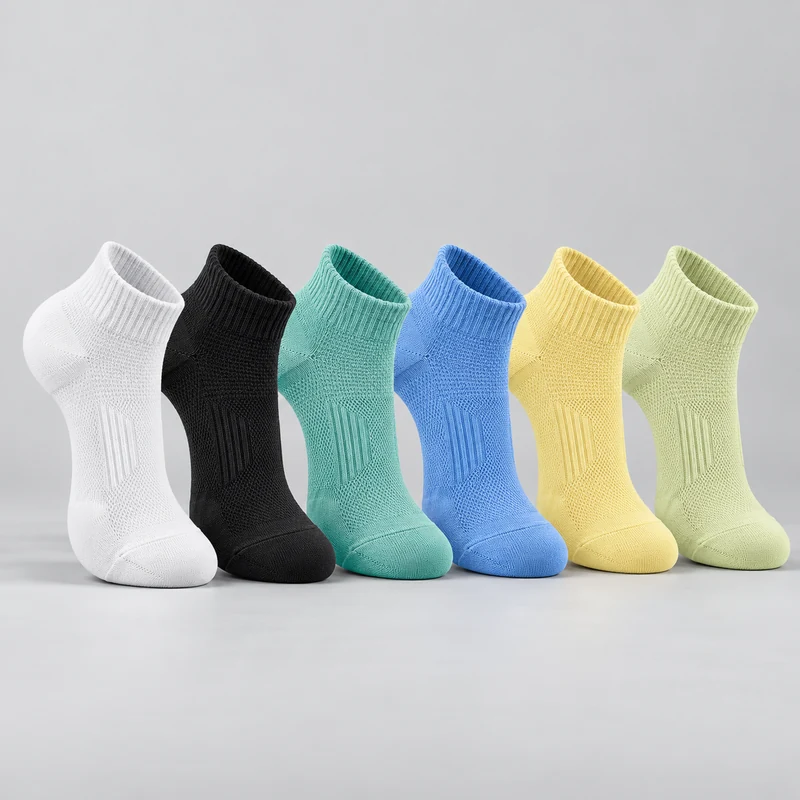
Custom Low-Cut Mesh Running Socks
Plain low-cut cuff, mesh-knit body and ribbed arch section. Plan core colours, seasonal shades, sizes and private label packs.
View Product Details →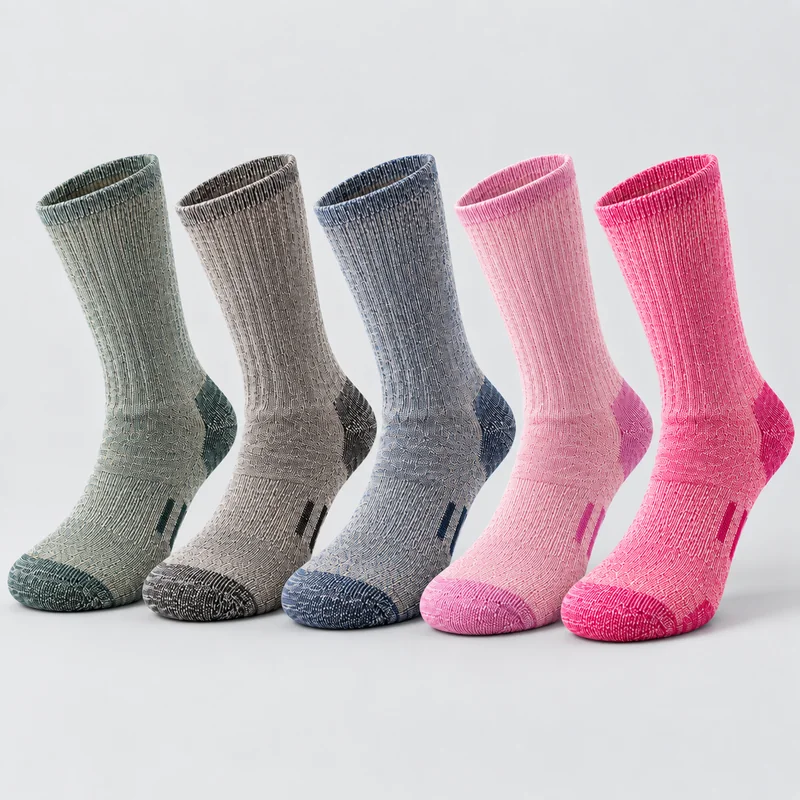
Custom Heather Hiking Socks
Heather yarn texture, ribbed crew cuffs and contrast heel and toe. Develop a winter outdoor range with custom colours, sizes and branded packaging.
View Product Details →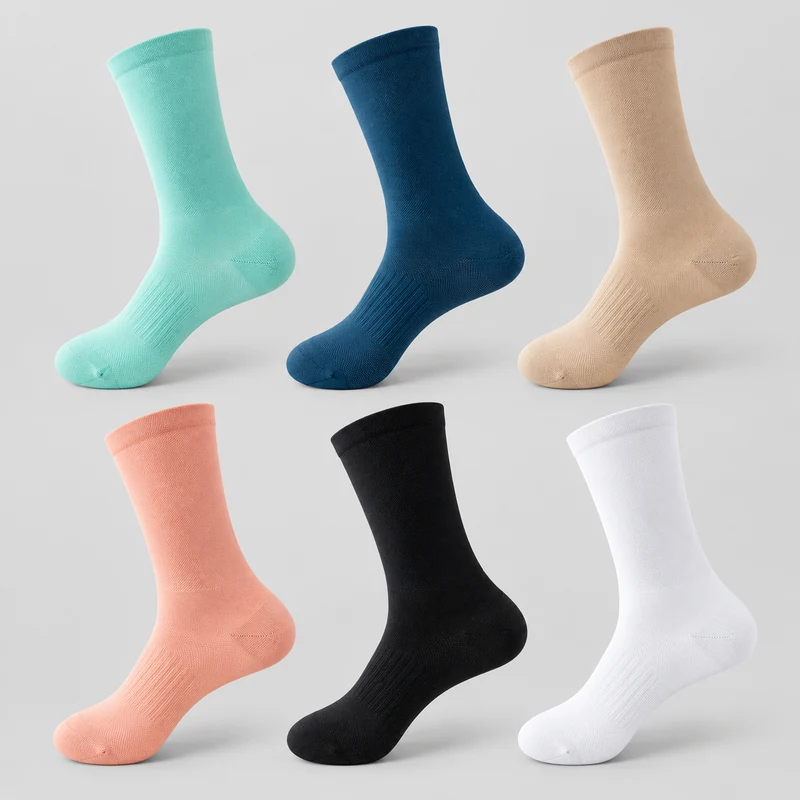
Custom Crew Cycling Socks
Solid colours, a smooth cuff and shaped arch knit. Plan rider sizes, club colours and branded packs for your cycling range.
View Product Details →These styles are design references. Yarn, thickness, cushioning and timing are confirmed for each order and construction.
3. Work backwards from the on-shelf date
Set the date stock must be ready to sell in each market, then subtract each stage. Use confirmed figures; where a figure is not yet confirmed, leave it as a field and do not commit to the launch date until it is filled in.
| Stage (latest first) | Where the duration comes from | Duration |
|---|---|---|
| On-shelf or event date | Your retailer, club or event calendar. | [date] |
| Receiving and distribution | Your warehouse, the retailer's receiving window or the club's handout date. | [days] |
| Customs and delivery buffer | Your customs broker and forwarder. | [days] |
| Freight | Your forwarder's quote for the chosen method and route. | [days] |
| Bulk production | The quotation. Standard grip styles: 12–16 working days from the confirmed production start. | [working days] |
| Approval to production start | Sample approval, final artwork, quantities and payment terms confirmed in writing. | [days] |
| Sample review and revisions | Your team's review time, plus any revised sample. | [days] |
| Sample shipping | Courier quote to your address. | [days] |
| Sampling | The quotation. Standard grip styles: 10–15 working days from the agreed schedule start. | [working days] |
| Brief and quotation | Your brief: style, colours, sizes, artwork, packs, destination. | [days] |
Planning worksheet with fields to complete. Working days exclude weekends and public holidays; convert them to calendar dates with the factory for your actual schedule.
The result is the latest date you can send the brief. If that date has already passed, simplify the launch rather than squeezing approvals: fewer colours, existing approved constructions, standard packing.

4. Buffers worth keeping
A schedule that only works if every stage finishes on its earliest day will usually slip somewhere. Common places to keep slack:
- A second sample round. Colour, logo or fit often needs one revision. Plan for it on a new construction.
- Holiday periods. Public holidays in the producing country and in your market pause work and logistics. Many factories and logistics services in China slow down around the Lunar New Year, so ask how holidays affect your quoted schedule.
- Freight peaks. Busy shipping periods can affect space and transit. Confirm with your forwarder close to booking.
- Customs and receiving. Paperwork queries or a retailer's receiving appointment can add days at the destination.
Our international order brief recommends treating sample approval, production start, shipping and arrival as separate milestones, and that is the safest way to track them.
5. One approved construction, two seasons
A cross-hemisphere range is easier to manage when the construction stays the same and only the visible parts change:
- Approve the base once. Construction, size chart and grip layout (if any) are fixed on one approved sample.
- Change colours by season. A warm-season and a cool-season colour story can share the same knit, sizes and packaging format.
- Alternate the production slots. The northern summer order and the Australian summer order fall roughly six months apart, which spreads production and reorders across the year.
- Keep one record per version. Each colourway and pack format is its own line in the reorder file, linked to the same approved construction. Our quality and reorders page explains how.
Seasonal colours are also how our wholesale page suggests growing a range: keep the core sellers stable and rotate limited colour updates around them.
6. Quantities and reorders by market
Each market's order is planned line by line. For standard grip styles, the minimum is 50 pairs per style, per colour and per size, and small quantities in different lines do not combine. Other constructions are quoted separately. Two points are specific to seasonal planning:
- Size mixes differ by market. Do not copy one market's size split into the other; use each market's own sales or customer data. Our size range guide covers how to label sizes consistently across markets.
- Reorders have a deadline. A mid-season reorder only helps if it arrives before the season ends. Set the reorder point early enough to allow the full production and freight time, as in our reorder point calculation.
7. Selling to European retailers
Europe is several markets, not one. When a northern-hemisphere launch includes European retailers, plan by country:
- Name the destination countries. Delivery, receiving windows and retail calendars differ by country and by retailer.
- Labelling language. In the EU, fibre composition must be labelled in the official language or languages of the Member State where the product is sold to consumers, unless that state provides otherwise (Article 16, Regulation (EU) No 1007/2011). A multilingual label or pack can cover several countries, if every required language is included.
- The UK is separate. Great Britain applies its own textile labelling rules under the Textile Products (Labelling and Fibre Composition) Regulations 2012, so treat UK and EU packaging as separate checks.
- Size labels. EU sizes are a common reference on continental European packs; add UK sizes for the UK. See the size conversion guide.
- Packs and barcodes. Each retailer may specify its own pack format, barcode and carton labelling. Collect those requirements before sampling the pack.
Check the current rules for each country with your compliance adviser before printing packaging.
8. A two-market planning summary
| Decision | Include in your brief | Confirm before committing |
|---|---|---|
| Markets and dates | Destination countries and postcodes, on-shelf or event date for each. | Freight method, transit estimate and receiving arrangements per market. |
| Construction | The styles shared across markets, and any market-only style. | One approved sample per construction. |
| Seasonal colours | Warm-season and cool-season colour references. | Approved colour standards for each version. |
| Quantities | Pairs per style, colour and size for each market. | Minimums, sampling and production timing in the quotation. |
| Labels and packs | Languages, size systems, barcodes and pack formats per market. | Packed samples for each market's version. |

Frequently asked questions
When is summer in Australia?
Australia's summer is usually counted as December to February, with winter from June to August. That is roughly the opposite of Europe, the UK and North America.
How far ahead should we plan a seasonal sock launch?
Work backwards from the on-shelf date through receiving, freight, production, approvals and sampling, using confirmed figures. Standard grip styles have published sampling and production working days; other constructions and all freight are confirmed per order.
Can one sock range serve both hemispheres?
Often, yes. Keep one approved construction and size chart, change the colour story by season, and plan separate launch dates and quantities for each market.
Do you hold stock in Australia, Europe or the US?
No. Products are made in Zhejiang, China, and no US, UK, European or Australian warehouse stock is represented. Dispatch arrangements and timing are confirmed for each order.
Can we treat Europe as one market for labelling?
Not safely. In the EU, fibre composition must be labelled in the official languages of each Member State where the product is sold, unless that state provides otherwise, and Great Britain has its own rules. Plan packaging country by country.
Next steps
Check how lines are counted on Samples & MOQ, review range structure on wholesale and distribution, and send each market's dates and quantities through the quote form.